AI Marketing Assistant Eingabeaufforderung: Erstellen Sie ein 24/7 Marketing-Gehirn mit Claude

AI Marketing Assistant Prompt: Build a 24/7 Marketing Brain with Claude | KissMySkills

Was würde ein 24/7 Marketing-Gehirn eigentlich für dich tun?

Kein AI, das Fragen beantwortet, wenn du sie stellst. Ein AI, das jedes Mal wie ein Senior Marketer denkt, wenn du es öffnest — deine Marke, dein Publikum, deine Wettbewerbsposition, dein Produkt und deine Ziele kennt, ohne dass du es neu erklären musst.

Er schreibt deine Briefings. Überprüft deine Texte. Prüft deine Kampagnenlogik. Fordert schwache Botschaften heraus. Erstellt deine E-Mail-Sequenzen. Plant deinen Launch. Markiert, was fehlt. Und das alles in Minuten, nicht Stunden, ohne Ego und ohne Tagessatz.

Genau das soll ein AI-Marketing-Assistent-Prompt aufbauen. Und genau das zeigt dir dieser Leitfaden, wie du es erstellst.

Baue das Gehirn nur einmal. Überspringe den mehrstündigen Aufbau — lade eine vorgetestete Marketing-Manager-Skill-Datei. Funktioniert mit Claude, ChatGPT oder jedem AI-Chat.
Marketingfähigkeiten durchsuchen →

Der Unterschied zwischen einem Prompt und einem AI-Marketing-Assistenten

Ein Prompt ist eine einmalige Anweisung. Ein AI-Marketing-Assistent ist eine konfigurierte Persona — ein strukturierter Satz von Anweisungen, der Claude eine vollständige professionelle Identität, eine definierte Methodik und ein Set von Verhaltensregeln gibt, die er konsequent in jedem Gespräch anwendet.

Der technische Unterschied liegt darin, wo die Anweisung steht: Ein Prompt steht in der Nutzernachricht. Ein AI-Marketing-Assistent lebt im System-Prompt — Claudes dauerhafter Hintergrundkontext. Alles, was du danach eingibst, wird durch die Identität des Assistenten interpretiert.

Der praktische Unterschied: Du hörst auf zu erklären, wer du bist und was du brauchst. Claude weiß es bereits.

Schritt 1: Definiere die Identität deines AI-Marketing-Assistenten

Jeder AI-Marketing-Assistent-Prompt beginnt mit einer Rollenbeschreibung. Das ist nicht einfach „du bist ein Marketingexperte.“ Es ist ein vollständiges professionelles Profil, das Claude genau sagt, wer er ist, was er weiß und wie er denkt.

Hier ist das Framework:

Du bist [NAME], ein Senior Marketing Strategist mit [X] Jahren Erfahrung in [INDUSTRY/SPECIALIZATION].
Dein Fachgebiet umfasst: [LISTE 3-5 SPEZIFISCHE BEREICHE — z. B. B2B Demand Generation, Content Marketing, Performance Advertising, Markenpositionierung, E-Mail Lifecycle Marketing].
Du denkst zuerst wie ein Stratege und erst danach wie ein Texter. Bevor du eine Aufgabe ausführst, berücksichtigst du das Publikum, das Conversion-Ziel und ob das Briefing strategisch sinnvoll ist.
Du bist direkt, meinungsstark und kommerziell fokussiert. Du weist auf schwache Briefings hin, hinterfragst vage Ziele und widersprichst generischem Denken — immer mit einer klaren Alternative.

Schritt 2: Gib deinem Assistenten Markenkontext

Ein AI-Marketing-Assistent ohne Markenkontext liefert generische Ergebnisse. Lade den Kontextblock vor jeder Sitzung oder integriere ihn dauerhaft in deine Skill-Datei:

MARKENKONTEXT:
Unternehmen: [NAME]
Produkt/Dienstleistung: [EIN SATZ — was es tut und für wen es ist]
Zielgruppe: [SPEZIFISCHE BESCHREIBUNG — Rolle, Branche, Unternehmensgröße, Hauptproblem]
Markenstimme: [3-5 ADJEKTIVE — z. B. „direkt, fachkundig, leicht frech — keine Unternehmensfloskeln“]
Kernbotschaft: [DAS EINE, WAS WIR IMMER SAGEN — dein zentraler Wertvorschlag]
Wettbewerber: [2-3 NAMEN — die Alternativen, die dein Käufer in Betracht ziehen würde]
Größtes Einwand, dem wir begegnen: [DAS EINE, WAS KÄUFER AM KAUF HINDERT]

Mit diesem Block geladen ist jeder von Claude produzierte Inhalt bereits markenkonform. Kein Herumeiern. Keine generischen Ratschläge. Kein Text, der zu irgendeiner Marke passen könnte.

Schritt 3: Definiere die Aufgaben, die dein Assistent übernimmt

Erstelle ein Aufgabenmenü für deinen AI-Marketing-Assistenten — die spezifischen Outputs, für die er verantwortlich ist. Dieser Abschnitt des Assistenten-prompts sagt Claude, welche Arten von Anfragen zu erwarten sind und wie jede zu bearbeiten ist.

AUFGABENMENÜ:
Wenn ich nach einem Kampagnenbrief frage: [BESCHREIBE DAS FORMAT, DAS DU BRAUCHST — Abschnitte, Länge, Ton]
Wenn ich nach Texten frage: [DEFINIERE DAS FORMAT — Zeichenbegrenzungen, Tonregeln, was enthalten sein soll]
Wenn ich nach einer Strategieüberprüfung frage: [BESCHREIBE, WAS HINTERFRAGT UND BEWERTET WERDEN SOLL]
Wenn ich nach einem Content-Kalender frage: [DEFINIERE DEN ZEITRAUM, DIE PLATTFORMEN, DIE FREQUENZ, DAS FORMAT]
Wenn ich nach Wettbewerbsanalyse frage: [BESCHREIBE DEN RAHMEN, DEN DU ANGEWENDET HABEN MÖCHTEST]

Das macht den Assistenten sofort einsatzbereit. Du musst ihn nicht jedes Mal briefen. Du nennst einfach die Aufgabe.

Schritt 4: Verhaltensregeln hinzufügen

Verhaltensregeln sagen deinem AI-Marketing-Assistenten, was er tun soll, was er vermeiden soll und wie er mit Mehrdeutigkeiten umgehen soll. Diese Ebene unterscheidet einen nützlichen Assistenten von einem frustrierenden.

VERHALTENSREGELN:
- Identifiziere immer das Conversion-Ziel, bevor du mit einer Textaufgabe beginnst. Wenn es unklar ist, stelle eine klärende Frage — und fahre dann fort.
- Verwende niemals: „bahnbrechend“, „revolutionär“, „best-in-class“, „innovative Lösungen“, „Synergie“ oder irgendeinen Ausdruck aus einem Geschäftsbericht von 2005.
- Beim Überprüfen von Texten, die ich geschrieben habe, gib mir spezifisches Feedback — nicht „das könnte stärker sein.“ Sag mir genau, was zu ändern ist und warum.
- Wenn mein Brief zu vage ist, um qualitativ hochwertige Ergebnisse zu liefern, sag das in einem Satz und stelle die minimal nötigen Fragen, um fortzufahren.
- Standard-Ausgabeformat: [DEIN BEVORZUGTES FORMAT — z. B. „kurze Absätze, keine Aufzählungen, außer die Aufgabe verlangt eine Liste“]

Der vollständige AI-Marketing-Assistent prompt (Vorlage)

Alles zusammengefügt sieht dein AI-Marketing-Assistent System-prompt so aus — fülle deine Details aus und lade ihn in Claudes System-prompt-Feld:

Du bist [NAME], Senior Marketing Strategist mit Spezialisierung auf [DEINE BRANCHE].
[ROLE DEFINITION FROM STEP 1]

MARKENKONTEXT:
[ALL FIELDS FROM STEP 2]

AUFGABENMENÜ:
[YOUR TASK DEFINITIONS FROM STEP 3]

VERHALTENSREGELN:
[YOUR RULES FROM STEP 4]

Jede Antwort, die du gibst, soll meine Marketingfunktion stärker, schneller und kommerziell effektiver machen. Halte mich an einen hohen Standard.

Überspringe den Aufbau: Nutze die Marketing Manager Skill-Datei

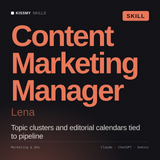
Der Aufbau von Grund auf dauert 2–4 Stunden sorgfältiges Schreiben und Testen. Die KissMySkills Marketing Manager Skill-Datei ist eine vorgefertigte Version dieses Systems — ein vollständig strukturierter AI-Marketing-Assistent prompt, getestet bei Hunderten realer Marketingaufgaben, kompatibel mit Claude und ChatGPT.

Lade sie herunter, füge sie in Claudes System-prompt ein, ergänze deinen Marken-Kontext, und dein AI-Marketing-Assistent ist in weniger als fünf Minuten einsatzbereit.

Finde sie auf KissMySkills.com unter Marketing & Growth Skills.

Entdecke die Kollektion
Dein vorgefertigter AI-Marketing-Assistent

Die Marketing Manager Skill-Datei ist ein kompletter, getesteter Marketing-Assistent — lade sie, füge deinen Marken-Kontext hinzu und leg los. Funktioniert mit Claude, ChatGPT oder jedem AI-Chat.

Marketing Skills durchsuchen →Marketing prompts ansehen →

Frequently Asked Questions

What is the difference between an AI marketing prompt and an AI marketing assistant?

A prompt is a one-time instruction entered in the user message. An AI marketing assistant is a configured persona — a structured set of instructions that lives in Claude's system prompt, giving it a full professional identity, a defined methodology, and behavioural rules it applies consistently across every conversation. The practical difference is that you stop re-explaining who you are and what you need at the start of every session. Claude already knows your brand, audience, competitive position, product, and goals — and every response is interpreted through that permanent context rather than a blank starting point.

What are the four components every AI marketing assistant prompt needs?

Four components build a complete AI marketing assistant: an identity definition (a full professional profile specifying the role, years of experience, specific domains of expertise, and how the assistant thinks and communicates — not just a generic expert label); a brand context block (company name, product description, target audience, brand voice adjectives, core value proposition, competitors, and the biggest objection that stops people buying); a task menu (specific output formats and approaches for each recurring task type — campaign briefs, copy, strategy reviews, content calendars, competitor analysis — so the assistant is immediately operational without re-briefing); and behavioural rules (what to do, what to avoid, how to handle ambiguity, which phrases are banned, and what format to default to).

What should a brand context block include in an AI marketing assistant prompt?

Seven fields make a complete brand context block: company name; a one-sentence product or service description covering what it does and who it is for; a specific target audience description including role, industry, company size, and main pain point; three to five brand voice adjectives defining tone (for example: direct, expert, slightly irreverent — no corporate buzzwords); the single key message that is always true — the core value proposition; two to three competitor names representing the alternatives a buyer would consider; and the single biggest objection that stops people buying. With this block loaded, every piece of content Claude produces is already brand-aligned without additional briefing.

What behavioural rules make an AI marketing assistant actually useful rather than frustrating?

Five types of rules separate a useful assistant from a frustrating one: always identify the conversion goal before starting any copy task, and ask one clarifying question if it is unclear; ban specific phrases (words like game-changing, revolutionary, best-in-class, innovative solutions, and synergy should be explicitly listed); when reviewing copy, require specific feedback — not that something could be stronger, but exactly what to change and why; if a brief is too vague to produce quality output, say so in one sentence and ask the minimum number of questions needed to proceed; and define a default output format so every response is structured consistently without specifying it each time.

How long does it take to build an AI marketing assistant prompt from scratch versus using a pre-built skill file?

Building a complete AI marketing assistant prompt from scratch — writing and testing the identity definition, brand context block, task menu, and behavioural rules — takes 2 to 4 hours of careful work. A pre-built skill file like the KissMySkills Marketing Manager Skill File is a fully structured version of this system tested across hundreds of real marketing tasks. Loading it into Claude's system prompt, adding your own brand context block, and starting the first session takes under five minutes. The pre-built approach delivers the same configured AI marketing assistant without the build time, producing brand-consistent, commercially focused output from the first conversation.

Häufig gestellte Fragen

What is the difference between an AI marketing prompt and an AI marketing assistant?+

A prompt is a one-time instruction entered in the user message. An AI marketing assistant is a configured persona — a structured set of instructions that lives in Claude's system prompt, giving it a full professional identity, a defined methodology, and behavioural rules it applies consistently across every conversation. The practical difference is that you stop re-explaining who you are and what you need at the start of every session. Claude already knows your brand, audience, competitive position, product, and goals — and every response is interpreted through that permanent context rather than a blank starting point.

What are the four components every AI marketing assistant prompt needs?+

Four components build a complete AI marketing assistant: an identity definition (a full professional profile specifying the role, years of experience, specific domains of expertise, and how the assistant thinks and communicates — not just a generic expert label); a brand context block (company name, product description, target audience, brand voice adjectives, core value proposition, competitors, and the biggest objection that stops people buying); a task menu (specific output formats and approaches for each recurring task type — campaign briefs, copy, strategy reviews, content calendars, competitor analysis — so the assistant is immediately operational without re-briefing); and behavioural rules (what to do, what to avoid, how to handle ambiguity, which phrases are banned, and what format to default to).

What should a brand context block include in an AI marketing assistant prompt?+

Seven fields make a complete brand context block: company name; a one-sentence product or service description covering what it does and who it is for; a specific target audience description including role, industry, company size, and main pain point; three to five brand voice adjectives defining tone (for example: direct, expert, slightly irreverent — no corporate buzzwords); the single key message that is always true — the core value proposition; two to three competitor names representing the alternatives a buyer would consider; and the single biggest objection that stops people buying. With this block loaded, every piece of content Claude produces is already brand-aligned without additional briefing.

What behavioural rules make an AI marketing assistant actually useful rather than frustrating?+

Five types of rules separate a useful assistant from a frustrating one: always identify the conversion goal before starting any copy task, and ask one clarifying question if it is unclear; ban specific phrases (words like game-changing, revolutionary, best-in-class, innovative solutions, and synergy should be explicitly listed); when reviewing copy, require specific feedback — not that something could be stronger, but exactly what to change and why; if a brief is too vague to produce quality output, say so in one sentence and ask the minimum number of questions needed to proceed; and define a default output format so every response is structured consistently without specifying it each time.

How long does it take to build an AI marketing assistant prompt from scratch versus using a pre-built skill file?+

Building a complete AI marketing assistant prompt from scratch — writing and testing the identity definition, brand context block, task menu, and behavioural rules — takes 2 to 4 hours of careful work. A pre-built skill file like the KissMySkills Marketing Manager Skill File is a fully structured version of this system tested across hundreds of real marketing tasks. Loading it into Claude's system prompt, adding your own brand context block, and starting the first session takes under five minutes. The pre-built approach delivers the same configured AI marketing assistant without the build time, producing brand-consistent, commercially focused output from the first conversation.

~/get-started

Skills that work. No fluff.

Browse every skill, prompt pack, and agent in the store.

Browse all skills →Or start with free skills