Before You Hire an AI Specialist, Know Which One You Actually Need
The job title "AI specialist" has become one of the most ambiguous roles in the marketing labour market. In one organisation, an AI specialist is a creative marketing generalist who writes excellent prompts and maintains a shared prompt library. In another, the same title describes a Python-fluent data scientist building custom machine learning models. In a third, it describes a marketing operations engineer who connects AI steps across Zapier workflows. These are fundamentally different people with different skills, different salary expectations, and different impact on the marketing function.
The first and most expensive mistake organisations make when they decide to hire an AI specialist is writing the job description before deciding which type of specialist they actually need. The result: a generic "AI Specialist" job ad attracts applicants from across all four categories, interview processes struggle to differentiate between them, and the eventual hire often solves a different problem than the one the organisation needed solving. Six months later, the new hire is doing work nobody needed and leaving the original capability gap unfilled.
This guide covers the four distinct types of marketing AI specialist, the salary ranges for each in 2026, the interview questions that differentiate strong candidates from weak ones, and the honest question every hiring manager should ask before committing to a full-time specialist hire at all.

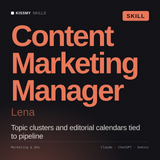
Covers most of the Type 1 job description above - prompt library, brand voice, content workflow discipline - as a configured skill file your existing team loads in an afternoon, before you open a specialist requisition.
View Lena →The Four Types of Marketing AI Specialist in 2026
Before writing the job description, match the role profile to the actual capability gap in your marketing function:
Type 1: Prompt Engineer / AI Content Strategist
This specialist builds and maintains the organisation's AI prompt library, skill file configurations, brand voice instructions, and AI content production workflows. They train the marketing team on effective AI use, produce consistently high-quality output from AI tools, and serve as the internal expert on "how do we get better output from Claude for this task." They do not code. They do not build ML models. They are a marketing expert who has become fluent in AI tools faster than the rest of the team.
Best fit for organisations where: the marketing function produces significant content volume, team AI fluency is inconsistent, and the opportunity is better AI output from existing tools rather than custom ML infrastructure.
Salary range in 2026: £45,000-£75,000 depending on seniority, location, and the content complexity expected. Remote-friendly roles trend to the higher end because the talent pool is global.
Who to look for: A strong marketing generalist with 2+ years of hands-on AI tool experience, a portfolio demonstrating AI-assisted work across multiple formats, and the ability to explain their prompt choices clearly. Evidence of having built prompt libraries, style guides, or skill-file-like configurations for previous employers is a strong positive signal.
Type 2: Marketing Operations + AI Integration Specialist
This specialist builds AI automation workflows using no-code and low-code tools (Zapier, Make, n8n), integrates AI features into the existing marketing stack, and manages the technical infrastructure of AI-powered campaigns. They understand APIs conceptually, can build multi-step workflows that pass data between platforms, and maintain the operational backbone of automated AI work. Some Python or JavaScript ability is helpful for edge cases but not required.
Best fit for organisations where: the marketing stack has 10+ tools, cross-tool automation is strategic, and the opportunity is connecting existing AI features into cohesive workflows rather than building new AI from scratch.
Salary range in 2026: £50,000-£85,000. The premium above pure prompt engineering reflects the technical integration skills required.
Who to look for: A marketing operations professional with demonstrable Zapier or Make workflow portfolios, API integration experience, and familiarity with the major AI platforms (Claude, OpenAI, Anthropic console, major ESP AI features). Ask them to walk through a complex workflow they've built - the specificity of the explanation tells you everything about their real skill level.
Type 3: Data Scientist or ML Engineer for Marketing
This specialist builds custom machine learning models for lead scoring, churn prediction, attribution modelling, demand forecasting, and predictive audience targeting. Requires Python, statistical modelling, data engineering, and enough infrastructure knowledge to deploy models into production. Effectively a data scientist specialised in marketing applications.
Best fit for organisations where: the marketing function is genuinely data-rich (large customer base, multiple years of structured history, significant conversion volume), and off-the-shelf AI features in existing platforms cannot address the prediction problems the business actually needs solved.
Salary range in 2026: £70,000-£120,000, with the upper end for senior ML engineers with strong marketing domain knowledge. This combination of skills is rarer than either skill alone and commands a substantial premium.
Who to look for: A data scientist with demonstrated marketing domain knowledge rather than generic ML experience. The combination matters enormously - a generic data scientist unfamiliar with marketing concepts (CLV, attribution, cohorts, funnel metrics) will spend the first six months learning your domain before producing useful work. Hire for both skillsets or expect the ramp.
Type 4: AI Strategy Consultant (Fractional)
This specialist defines the organisation's AI marketing roadmap, evaluates platform options, advises on implementation sequencing, and provides external expert validation of strategic choices. Typically engaged on a fractional basis (2-4 days per month) rather than full-time. The role is less about hands-on execution and more about strategic direction and decision support for the existing team.
Best fit for organisations where: the marketing team is capable of executing AI work but uncertain about strategic choices - which platforms to commit to, how to sequence deployment, what the 12-24 month roadmap should look like.
Day rate in 2026: £600-£1,500 depending on seniority, specialism, and whether the engagement includes specific deliverables versus pure advisory.
The Interview Questions That Separate Strong AI Specialists From Weak Ones
Generic "do you know AI tools" questions produce generic answers. The questions below are designed to surface real capability differences across all four specialist types:
Questions for All AI Specialist Types
- "Walk me through how you would build a campaign brief using AI tools. What inputs would you give? What would you review before using the output?" Strong candidates describe specific prompt structures, context-loading approaches, and review criteria. Weak candidates describe generic "I'd ask Claude to write a brief" workflows.
- "Tell me about a specific time AI produced bad output in a work context. What was the failure, and how did you catch it before it caused a problem?" Strong candidates have concrete examples of AI failures they've caught - hallucinated statistics, off-brand tone, logical errors in reasoning. Weak candidates haven't hit enough real-world AI failures to have a substantive answer.
- "How do you stay current with AI tool developments? What has changed in the last 3 months that has affected how you work?" Strong candidates name specific recent developments (model releases, feature updates, platform changes) and connect them to their workflow. Weak candidates give general "I follow AI news" answers.
Type-Specific Questions
- For prompt engineers: "Show me a prompt you've written that you're proud of. Why is it structured that way?"
- For marketing ops integrators: "Describe the most complex multi-tool workflow you've built. Walk through each step and why you chose that architecture."
- For data scientists: "Walk me through a churn prediction model you've built. What features did you include, what did you exclude, and what was the accuracy on holdout data?"
- For strategy consultants: "Give me an example of an AI platform decision you've advised a client against. What was the reasoning?"
Before You Hire an AI Specialist: The Question Most Organisations Don't Ask
Before committing to a full-time specialist hire, the honest question worth asking is whether a targeted AI skills upgrade for existing team members would deliver more value at a fraction of the cost. A comprehensive KissMySkills skill file library deployed across the marketing team, paired with a half-day training session on effective AI usage patterns, can close a substantial portion of the AI capability gap for an existing marketing team at roughly 1% of the annual cost of a specialist hire.
This isn't an argument against hiring AI specialists. It's an argument for sequencing the investment correctly. The organisations getting the best AI leverage in 2026 are typically the ones that upskilled existing team members first - which surfaced the specific capability gaps that existing teams genuinely couldn't close - and then hired specialists targeted at those specific gaps, rather than hiring generalist AI specialists hoping they'd figure out the right problems to solve.
When Hiring an AI Specialist Is Genuinely the Right Move
Full-time AI specialist hiring makes sense when one or more of these conditions is clearly true:
- The marketing function has identified a specific, substantial capability gap that tool-augmented existing team members cannot close
- The volume of AI-related work exceeds what existing team members can handle alongside their primary responsibilities
- The organisation needs credible internal expertise for stakeholder communication about AI strategy and decisions
- The marketing function requires custom ML work that no-code platforms cannot address
- AI is a strategic differentiator the organisation is choosing to invest in meaningfully, not a tactical optimisation
If none of these conditions apply, the smarter investment is upskilling the existing team with configured AI tools rather than hiring a specialist. Browse the KissMySkills team skill packs at KissMySkills.com to close internal AI capability gaps before opening a specialist hiring requisition.
Ready to put this into practice? Browse Marketing & Ads skills for Claude & ChatGPT, or explore all Claude skills and the prompt library.