AI Agents Are Not What Most People Think
When most people hear "agents in artificial intelligence," they picture something from a science fiction film. The reality is far more practical - and far more useful to anyone with a job to do.
An AI agent is a configured version of an AI model that does not wait for instructions. It takes charge of a task, asks the right questions to understand your specific situation, and delivers a complete output. The difference between an AI agent and a regular chat with Claude or ChatGPT is the difference between telling someone what to do and hiring someone who already knows how to do it.
The Practical Difference: Reactive vs. Proactive
Standard AI use looks like this: you type a prompt, the AI responds, you refine your prompt, the AI responds again. You do the thinking about what to ask. The AI provides the answer.
An AI agent works the other way around. You activate the agent, and it immediately takes charge - asking you targeted questions one at a time to understand your specific situation, gathering the context it needs, and then executing the task from start to finish. You provide the inputs. The agent does the work.
This distinction matters enormously for non-technical professionals. You do not need to know how to write a good prompt. You do not need to understand how the AI works. You paste one activation message, answer a handful of questions, and get a finished output.
What Agents in Artificial Intelligence Actually Do
The most useful AI agents for professionals today handle complete, multi-step professional tasks - the kind that previously required either specialist expertise or hours of your own time. Examples include:
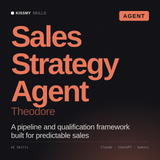
A sales strategy agent that asks about your product, ICP, and current challenges, then delivers a complete sales strategy with pipeline design, qualification framework, and 90-day execution plan. A code review agent that reviews your code for bugs, security issues, and performance problems, then delivers a structured report with fixes for every finding. A recruiting strategy agent that builds a complete hiring plan - sourcing channels, interview process, and candidate experience - based on the role and your company stage.
Each of these involves multiple steps, specialist knowledge, and judgment calls. An AI agent handles all three.

This is the sales strategy agent described above - it asks about your product, ICP, and current challenges, then delivers the pipeline design, qualification framework, and 90-day plan. No prompt writing required.
View Theodore →How AI Agents Work (Without the Technical Detail)
Every AI agent on KissMySkills consists of two files. The first is a skill file - a structured set of instructions that configures the AI into a specialist persona with specific knowledge, methodology, and output formats. This file goes into your Claude Project Instructions (or your ChatGPT system prompt).
The second is an activation prompt - a plain-language message you paste into the conversation that tells the agent to take charge. Once it reads the activation message, the agent begins asking you questions one at a time, gathering the context it needs, and then executing.
You do not need to write a prompt. You do not need to know what information the agent needs. The agent asks.
Who AI Agents Are For
AI agents are not built for developers or AI researchers. They are built for professionals who have complex, recurring work tasks that eat time and require expertise they may not have on staff.
A founder doing the CFO job without a CFO. A sales manager who needs outbound sequences written for ten different ICPs. An HR manager screening 80 applications for a role. A marketing manager who needs a campaign strategy before the next board meeting. These are the people AI agents are built for - and the reason they are one of the fastest-growing categories in professional AI tools.
AI Agents vs. Prompts: The Simple Distinction
A prompt tells the AI what to do once. An agent configures the AI to know how to do a whole job - and then leads you through it. Prompts are faster to set up. Agents are more powerful for complex, multi-step work. For most professionals, both have a place: prompts for quick, one-off tasks, agents for the work that recurs and requires real depth.
Where to Start
KissMySkills offers AI agents across seven professional categories - coding, marketing, sales, recruiting, business operations, finance, and SEO. Each agent includes the skill file and activation prompt. Load, paste, begin. No technical knowledge required.
Coding, marketing, sales, recruiting, business, finance, and SEO - each agent is a configured specialist that leads the task end-to-end. $39 each, set up in five minutes, no technical knowledge required.