The Honest Picture
The conversation about AI and professional work tends toward two equally unhelpful extremes. On one side: AI will replace most professional jobs within five years, and any role involving documents, analysis, or writing is at existential risk. On the other: AI is overhyped, the outputs are generic, and nothing has fundamentally changed about how knowledge work gets done.
Both positions are wrong in the ways that matter most. Something real is changing - but it is more specific, more nuanced, and more useful than either extreme suggests. Understanding what is actually changing, and what is not, is more valuable than a hot take in either direction.

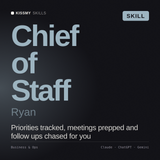
Handles exactly the methodology-execution layer this article describes - briefs, structured reports, first-pass analysis - so senior time stays on the judgment and relationship work agents can't do.
View Ryan →What Is Actually Changing
The cost and time required to produce high-quality first drafts of structured professional documents has fallen dramatically. A sales proposal that took three hours to write well now takes twenty minutes to produce with an agent and fifteen minutes to review and personalise. A technical SEO audit that took a day to complete takes two hours with an agent producing the structured output and a specialist reviewing and prioritising. A financial variance analysis that took a finance manager an afternoon takes forty minutes with an agent doing the first-pass analysis and the manager validating and contextualising it.
This change is concentrated in a specific category of professional work: tasks that were previously considered skilled because they required specific methodological knowledge, but where the methodology is codifiable and the genuine value comes from the human judgment applied to the output rather than the production of the output itself. Knowing the structure of a good proposal is not the same skill as knowing which proposal to make to which prospect at which moment. Knowing how to build a financial model is not the same skill as knowing which assumptions are conservative enough to be credible in an investor conversation.
The methodology layer of professional work is being automated. The judgment layer is not.
The Methodology-Execution Distinction
Most professional roles contain both methodology-execution work and judgment work - but in different proportions. An entry-level analyst spends 70% of their time producing outputs that follow defined methodologies (reports, models, analyses, presentations) and 30% of their time exercising judgment about what the outputs mean and what to do with them. A senior director spends 20% of their time on methodology execution and 80% on judgment, relationships, and decisions.
AI agents are exceptionally good at the 70% of the analyst's role and of limited additional value for the 80% of the director's role. This is why the impact is distributed unevenly across seniority levels - and why the economic case for junior roles in certain functions is weakening faster than the economic case for senior roles.
This does not mean junior roles are disappearing. It means the skills that justify a junior professional hire are shifting. Execution speed and methodological consistency - the things junior professionals provided that agents now provide more efficiently - are no longer the primary value proposition. Judgment, context, and the ability to work productively with AI output are becoming the minimum viable skills at every professional level.
Which Roles Are Most Affected
The roles experiencing the most significant change are those where the primary output is structured documents produced from a defined methodology: junior analysts producing financial reports, SDRs whose output is measured in sequences created and emails sent, entry-level content writers producing SEO articles to a brief, graduate HR coordinators screening CVs against defined criteria.
These roles are not disappearing in all cases - but their economic case is changing. A senior person with an AI agent can produce the outputs these roles produced, at equivalent or higher quality, in a fraction of the time. This changes the hiring calculus for the role, the expected output volume for anyone in the role, and the career path for people entering these roles expecting the traditional junior-to-senior progression based on execution speed.
The roles least affected - and in some cases more valuable - are those where the primary value is judgment built on experience, relationships developed over years, and accountability that clients, investors, or organisations place in a specific person rather than a process. Senior advisors, relationship managers, strategic leaders, and operators who make consequential decisions under uncertainty are not facing the same pressure. The premium on genuine judgment and accountability increases as mechanical execution becomes cheaper.
What Is Not Changing
Relationships require humans in ways that agents cannot replicate. A client who has worked with someone for a decade values the relationship partly because of what that person has done, and partly because of the trust, familiarity, and sense of accountability that accumulates through years of interaction. An AI agent produces the proposal; the human closes it. An AI agent builds the onboarding programme; the hiring manager delivers the first week experience that determines whether the new hire stays.
Novel judgment in genuinely ambiguous situations does not yet transfer to agents. An experienced operator who has been through a company crisis, a market downturn, a product failure, and a competitive threat all in the same quarter has pattern recognition - about what matters, what can wait, and what will look different in six months - that no current AI configuration can replicate. Agents execute from methodology. They do not navigate from experience.
Ethics, accountability, and representation require humans. The lawyer who advises on a complex situation is accountable for the advice in a way an agent is not. The board member who votes on a critical decision is accountable to shareholders. The manager who tells a team member their performance is not working is accountable to that person. These roles involve human accountability that cannot be delegated to a tool regardless of how good the tool's output is.
The Adaptation Path for Professionals
The professionals who benefit most from the current change are those who use agents to increase the quality and volume of their output - freeing time for the judgment, relationship, and strategic work that defines senior professional value. The professionals most at risk are those whose primary contribution is methodology execution at a seniority level where agents now produce equivalent output more efficiently.
The adaptation path is not complicated, but it is real. Identify the methodology-execution work in your current role - the documents, analyses, and structured outputs that follow a defined process. Learn which agents handle those tasks well. Redirect the time saved to the judgment and relationship work that agents cannot do. This is not a radical career change - it is a shift in how professional time is allocated, driven by new tools that change what is worth spending senior time on.
Where to Start
The clearest starting point is the task that currently consumes the most time and delivers the least of your unique professional value - which is almost always a structured document production task. A proposal, an analysis, a strategy, a plan. KissMySkills offers agents across seven professional domains covering exactly these tasks. Each is available individually, takes five minutes to set up, and produces a complete professional output in one session. The time returned is immediate. How that time gets redirected is the professional judgment that makes the difference.
Marketing, sales, finance, HR, legal, ops, and engineering - each agent is a ready-to-run skill file. Five minutes to set up, a complete professional output in one session.
Browse the AI Skills catalog →