An AI agent for data analysis does not just answer questions about a dataset - it plans the steps, writes and runs the queries or code, checks its own output, and keeps going until it reaches an answer. In 2026 that spans natural-language-to-SQL, exploratory analysis, data cleaning, root-cause digging and drafting the report at the end. Used well they save hours; used blindly they produce confident nonsense. Here is what they do, where they fail, and how to get reliable results.
What is an AI agent for data analysis?
The word "agent" is stretched to cover almost anything, so here is a simple test: give it a goal where the correct second step depends on what the first step returns. If it still runs a fixed sequence, it is a prompt chain. If it reads the result and picks a different next move - run a query, notice an outlier, decide to segment, run another - it is an agent. For the full breakdown of prompt versus skill versus agent, see our guide to the best AI agents.
What can they actually do?
The genuinely useful jobs today are the repetitive, mechanical ones:
- Natural-language-to-SQL: ask a question in plain English, get the query and the result.
- Exploratory analysis: summarise a fresh dataset, flag distributions, correlations and outliers before you dig in.
- Cleaning and transformation: spot missing values, fix types, reshape and join tables.
- Root-cause analysis: "why did signups drop last week?" - the agent slices the data several ways looking for the driver.
- Reporting: turn the findings into a readable summary or the outline of a dashboard.

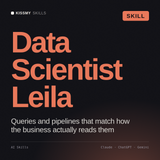
A general chatbot guesses at your data. Leila gives Claude a real data-science method: exploratory analysis, statistics, A/B test design and modelling, with the reasoning shown so you can check it. Hand it a dataset and get a defensible answer, not a confident one.
View Leila →Where they fail
This is the section most roundups skip, and it is the one that saves you from shipping a wrong number.
They invent structure. An agent will happily reference a column or table that does not exist, or join two tables on a key that looks right and is not. The query runs, a number comes back, and nothing flags that it is meaningless.
They compound their own mistakes. Because each step builds on the last, a misunderstanding in step two is baked into steps three through ten. By the time you read the summary, the error is load-bearing and the reasoning around it reads as confident.
They lack your context. The agent does not know that "test accounts" should be excluded, or that a spike was a one-off campaign. It optimises for a plausible answer, not a correct one. That gap is exactly why a defined method - see real examples of agents at work - beats a blank chatbot.
How to get reliable results
- Give it the schema and the context. Tell it the tables, the columns, what to exclude and what the metrics mean. Most bad answers trace back to missing context, not a weak model.
- Ask for the query, not just the answer. Always make it show the SQL or code. Reading it takes a minute and catches most silent errors.
- Work in small steps. Verify each stage before moving on, rather than trusting one long autonomous run.
- Keep a human on the irreversible calls. Let the agent do the analysis; you decide what goes in the board deck.
The best setup for most people
You have two routes. Build your own agent on a platform like Claude, ChatGPT or a workflow tool - flexible, but you write the method, the guardrails and the failure handling yourself. Or use a ready-made role that already has the method built in, which is faster for a specific job. If you want to build one from the ground up, start with how to build an AI agent.
Frequently asked questions
What is an AI agent for data analysis?
It is an AI system that takes a data question, plans the steps, writes and runs the queries or code, checks its own output and iterates until it reaches an answer - rather than just describing what you could do. The deciding-the-next-step part is what separates an agent from a chatbot.
Can AI agents replace a data analyst?
No. They speed up the mechanical parts - writing SQL, cleaning data, first-pass exploration and drafting reports - but they lack the domain context to know which questions matter and when a result is misleading. The reliable pattern is an analyst using an agent, not an agent working unsupervised.
What are the biggest risks?
Hallucinated column or table names, silently wrong joins, and confident answers built on a misunderstanding of the data. Because an agent chains steps, an early mistake gets baked into everything after it. Always ask to see the query or code, not just the answer.
Do I need to know how to code?
No. Most tools take a plain-English question and return both the answer and the underlying query. Knowing enough to read that query is what keeps you safe, but you do not need to write it yourself.

Do not want to build every prompt from scratch? This library has drop-in prompts for querying, cleaning, transforming and explaining data - paste, run and get usable output on the first try. Works with Claude, ChatGPT or any AI chat.
View the library →In summary: AI agents are excellent at the mechanical parts of data analysis and dangerous when trusted blindly - give them context, make them show their queries, and keep the judgement calls yours. If you want the role rather than a blank tool, browse skills and agents that run on Claude, or get the lot with KissMySkills Unlimited from $9/month.