Como usar o Claude como redator de anúncios: o guia do Skill Leo

Updated

A redação de anúncios é a escrita mais difícil que existe, porque você tem menos palavras. Um título de cinco palavras, uma descrição de quinze, uma única frase que precisa fazer alguém parar e agir - não há onde esconder uma palavra fraca. Usar o Claude como redator de anúncios dá a você um parceiro para essa compressão: uma ferramenta como Claude, ChatGPT ou qualquer chat de AI que transforma um benefício em uma frase, cria dezenas de variações para testar e respeita os limites rigorosos de caracteres impostos por cada plataforma. São as próprias palavras - o ângulo e a estratégia de testes são o trabalho relacionado em nosso guia de criação de anúncios.

Texto de anúncio curto e persuasivo
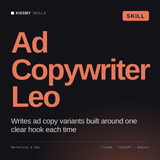
Leo - Skill de AI para redação de anúncios
$29esta Skill vs $500por campanha, um redator de anúncios

Frases curtas e persuasivas, criadas para os limites de cada plataforma, no volume necessário para testes reais, com chamadas para ação que realmente pedem uma ação. Funciona com Claude, ChatGPT ou qualquer chat de AI.

Ver Leo →

Um benefício por linha, expresso com precisão

O erro clássico é amontoar três argumentos de venda em um único título, fazendo com que nenhum deles se destaque. A Skill escreve textos que escolhem o único benefício que importa e o expressam com precisão - porque uma frase sobre uma coisa é melhor do que uma frase sobre tudo. A disciplina de saber o que deixar de fora é a maior parte do trabalho.

Recurso em benefício, benefício em desejo

“500 GB de armazenamento” é um recurso; “nunca mais exclua uma foto” é um benefício; o melhor texto de anúncio alcança o desejo por trás disso. A Skill faz essa tradução - do que o produto é para o que o leitor realmente quer - e essa é a diferença entre um texto que informa e um texto que vende.

Criada para os limites da plataforma

Um título para o Google, um texto principal para a Meta, um banner de display, um outdoor - cada um tem seu próprio limite de caracteres e ritmo. A Skill escreve dentro da restrição exata, em vez de entregar um texto que é truncado no meio da palavra. Escrever com precisão dentro do limite é uma Skill por si só.

Muitas variações, porque você vai testar

Um bom texto publicitário é descoberto, não escrito - você testa dez frases e duas vencem. A Skill oferece esse volume rapidamente: variações do gancho, do ângulo e da chamada para ação, para que você tenha um teste real, em vez de uma única frase preciosa à qual está apegado. A mesma técnica aprimora a persuasão em textos longos no nosso guia de redação focada em conversão.

Chamadas para ação que realmente fazem um pedido

Muitos anúncios descrevem e depois se esquecem de pedir algo. A Skill escreve chamadas para ação que dizem ao leitor exatamente o que fazer em seguida, de acordo com o ponto da jornada em que ele está - essa é a diferença entre um anúncio admirado e um anúncio clicado.

Por que uma Skill supera um prompt avulso

Uma Skill bem preparada reúne seu produto, sua voz e suas frases vencedoras, então cada novo lote aproveita o que já converteu, em vez de começar do zero. Ao longo de uma campanha, esse efeito cumulativo é o que torna o texto mais afiado.

O limite real

A Skill escreve textos fortes para candidatos; o mercado é o único juiz de qual frase realmente converte, e nenhuma frase inteligente supera um teste real. Trate o resultado como material para teste e deixe os números de cliques e conversões coroarem o vencedor. Usar o Claude como redator de anúncios dessa forma oferece o volume e a técnica necessários para vencer o tipo de texto mais difícil e enxuto que existe.

Guias de Skills relacionados

KissMySkills é um marketplace com mais de 300 Skills, prompts, agentes e ferramentas gratuitas de AI para Claude, ChatGPT e qualquer chat de AI.

Perguntas frequentes

Does Claude know the character limits for ad platforms?+

It will tell you a number confidently, and that is the problem. Limits differ by field, by placement and by ad type, they change, and they are not what you expect in every language. Google publishes that a responsive search ad headline supports up to 30 characters and a description up to 90, but also that in a double-width language such as Korean, Japanese or Chinese every character counts as two - so the same headline field is effectively 15. Supply the limit in your prompt and forbid the model from stating or correcting one.

Can AI count characters accurately?+

Not reliably. Text is broken into tokens before the model ever sees individual letters, so character counting is something these tools are structurally bad at. Have it print a count next to every line, because that is a useful sorting aid, then verify the counts yourself in a spreadsheet or a text editor. Three seconds of checking prevents an ad that truncates mid-word or gets rejected on submission.

What is the difference between writing to a limit and trimming to one?+

They produce completely different lines. Ask for a headline and then cut it to 30 characters and you get a mutilated sentence: it was built with a different rhythm and you have amputated the end. Set the width as the constraint before a single word exists and the line is conceived at that width. Compression is not editing. If an idea does not fit, the instruction should be to drop the idea rather than truncate the sentence.

How many ad variations should I generate?+

Far fewer than the model can produce, and the number is set by your budget rather than by its capacity. Every variant splits the same impressions, so beyond a handful none accumulates enough data to separate a real difference from noise, and the winner is whichever variant got lucky first. Two or three genuinely different claims tested properly beats fifteen phrasings tested badly. Use the model to find angles you had not considered, then throw most of them away before spending anything.

Why do my A/B tests never teach me anything?+

Usually because the variants differ on wording rather than on the claim. Save time on invoices and spend less time on invoices are the same promise, and running both costs money to learn what you already knew. Make each variant test a different claim: a different promise, a different objection answered, a different moment in the buyer's day, a different fear named. Then attach a hypothesis to each one and state in advance what result would prove the claim wrong rather than the phrasing.

Will AI write ad copy that gets rejected?+

It can, and it will not warn you. It reaches for superlatives, comparative claims, guarantees and second-person copy that asserts something about the reader, all of which are common rejection triggers. Run a disapproval pass before the copy reaches an ad account: ask it to review as a reviewer looking for reasons to reject, quoting the exact words, and to flag every superlative, every number and whether you or it supplied that number, and anything implying knowledge of the reader's health, finances, age or circumstances.

Can I ask the model what a platform's ad policy says?+

No, and this is the single most confidently wrong answer you will get from it. Platform policies change without announcement and the model answers from whatever version it last saw. Meta publishes a standard covering privacy violations and personal attributes within its advertising standards, Google has its own set, and each network differs. Use the model to flag where a line is risky. Read the current policy on the platform to decide whether it actually is.

How do I install the Leo skill?+

The download is a ZIP with SKILL.md at the root of the archive rather than inside a nested folder, which is the usual reason an upload fails. In the Claude desktop app open Customize, then Skills, upload the ZIP and toggle it on. Skills need code execution enabled, under Settings then Capabilities. Anthropic's help centre currently lists Skills on Free, Pro, Max, Team and Enterprise, while its Academy tutorial lists Pro, Max, Team and Enterprise, so if you are on the free plan check Settings then Capabilities for your own account rather than trusting either page. In ChatGPT or Gemini there is no upload step, so open SKILL.md, copy the contents and paste them into custom instructions.

~/get-started

Skills que funcionam. Sem enrolação.

Navegue por todas as skills, coleções de prompts e agents na loja.

Navegue por todas as habilidades →Ou experimente as ferramentas gratuitas