How We Chose These 35 Tools
This isn't a list of every AI tool that mentions marketing on its homepage. It's a category-by-category review of tools that marketing professionals are actually using in 2026 to ship more work, improve campaign performance, and reduce the cost of producing quality output.
Each tool was evaluated on three criteria: does it work reliably for the stated task, does it integrate with the existing marketing stack without significant friction, and does the value justify the price at the scale most marketing teams operate at.
Tools are organised by the marketing function they serve. Use the sections below to navigate to your category.
AI Tools for Content Marketing
Claude (Anthropic) - Best for long-form, structured, strategic content
Claude Sonnet 4 produces the highest-quality long-form marketing content of any model available in 2026. Unlike tools built around GPT, Claude handles nuance, avoids brand-killing genericism, and follows complex structural briefs precisely. With a properly configured skill file loaded, it functions as a senior content strategist rather than a drafting tool. Best for: blog posts, campaign briefs, email copy, content strategy documents.
Jasper - Best for brand voice consistency at scale
Jasper's brand voice training features make it the strongest choice for teams producing high volumes of content that must stay on-brand across multiple writers and markets. The AI output quality is below Claude's for complex tasks but its workflow integrations and template library make it practical for content operations teams. Best for: scaled content production, brand-regulated teams.
Surfer SEO - Best for SEO-optimised content
Surfer's SERP analysis and content scoring works. It tells you what to include, what to avoid, and how long to write - grounded in what's actually ranking for your keyword today. When combined with Claude for the actual writing, it produces content that ranks faster than either tool alone. Best for: SEO blog content, page optimisation.

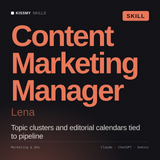
Claude, Jasper, and Surfer produce the content. Lena is the skill file that turns your content strategy into topic clusters, a 90-day editorial calendar, and briefs your team can execute from immediately.
View Lena →AI Tools for Email Marketing
Klaviyo AI - Best for ecommerce email automation
Klaviyo's AI predictive features - send time optimisation, product recommendations, churn prediction - are genuinely useful and the best-implemented AI feature set in an ESP in 2026. The generative copy features are competent but not remarkable. Best for: ecommerce brands with established email lists.
ActiveCampaign - Best for B2B lifecycle email with AI scoring
ActiveCampaign's lead scoring and predictive sending are well-implemented for B2B sequences. Strong automation builder with AI-assisted workflow suggestions. Better suited to B2B lifecycle marketing than ecommerce. Best for: SaaS and B2B companies running complex nurture sequences.
AI Tools for SEO
Semrush AI features - Best for integrated SEO workflow
Semrush has integrated AI across its keyword research, content audit, and competitive analysis tools in a way that genuinely reduces manual work. The AI Writing Assistant produces SEO-structured content that passes the basic usability test. Best for: teams who want SEO research and content in one platform.
Ahrefs - Best for backlink intelligence and keyword gap
Ahrefs remains the most reliable tool for backlink analysis and competitive keyword gap identification. Its AI features are newer and less integrated than Semrush's but its underlying data quality is stronger. Best for: technical SEO, link building strategy, competitor research.
Clearscope - Best for on-page content optimisation
Clearscope's content grading system tells writers which semantically related terms to include and at what frequency. The most focused tool in this list - it does one thing and does it well. Best for: content teams optimising existing pages and new articles for topical authority.
AI Tools for Paid Advertising
Google Ads Performance Max - Best for search and display automation
Performance Max has matured. In 2026 it works reliably for brands with sufficient conversion history. Feed it strong creative assets and let the algorithm optimise placement and bidding. The AI creative testing is genuine and measurable. Best for: brands with 50+ conversions per month looking to scale paid search.
Meta Advantage+ - Best for social paid scaling
Meta's Advantage+ campaign structure with AI creative testing and audience expansion works well for direct-to-consumer brands with strong creative libraries. Less effective for niche B2B audiences where AI audience expansion introduces too much noise. Best for: DTC brands with proven creative assets and conversion tracking in place.
Pencil - Best for AI ad creative generation
Pencil generates video and static ad creative variants at speed using your existing brand assets. The output quality has improved significantly in the last 12 months. Best positioned as a creative testing volume tool rather than a replacement for hero creative. Best for: performance marketing teams running high-volume creative tests.
AI Tools for Analytics and Reporting
Tableau AI features - Best for enterprise data visualization
Tableau's Einstein Copilot integration lets non-technical marketers query their data in plain language and get chart-ready visualisations. Removes the SQL barrier for marketing teams who live in dashboards. Best for: enterprise marketing teams with large datasets and non-technical stakeholders.
Polymer - Best for lightweight AI data exploration
Polymer converts spreadsheets and CSV exports into interactive dashboards with AI-powered insights. Much lower overhead than Tableau. Strong choice for smaller teams reporting weekly or monthly without a dedicated data analyst. Best for: SMB marketing teams and agencies producing client reports.
The AI Tool That Connects Your Whole Stack
Every tool above handles a specific function. The gap most marketing stacks have in 2026 is at the intersection: where strategy meets execution, where briefs become copy, where data becomes decisions.
Claude with a role-specific skill file fills that gap. It's the AI that understands your full marketing context and can operate across any function - content, email, SEO, analytics, campaign planning - without you switching tools or re-establishing context.
Load the Marketing Manager Skill from KissMySkills and add it to your 2026 marketing stack. It's the one addition that makes every other tool in this list work better.
Ready to put this into practice? Browse Marketing & Ads skills for Claude & ChatGPT, or explore all Claude skills and the prompt library.