If you want to buy Claude skills, the first question is where - and the honest answer is that the market is young enough that the options are not obvious yet. A Claude skill is a configuration file (usually a .md file) that turns Claude, ChatGPT, or any AI chat into a specialist for one role or task. You load it once and the model behaves like an expert from the first message. This guide walks through where to buy Claude skills, what separates a good one from a bad one, and what to expect on price.
Whether you are after a marketing specialist, a sales assistant, or a finance analyst, the buying decision comes down to the same few things: quality, fit for your role, and whether the seller actually tests what they ship.
What you are actually buying
A Claude skill is not software you install. It is a structured instruction file that loads your role, methodology, and output rules into the model. Drop it into Claude Projects or paste it as a system prompt in ChatGPT, and every response comes back already shaped for the job - a marketing skill writes briefs the way a senior marketer would, a finance skill analyses numbers the way an analyst would. That is the difference between a generic chat and a configured specialist.

"A finance skill analyses numbers the way an analyst would" - this is that skill. Specific to one role, clear output format, tested against real financial analysis tasks before it shipped.
View Miles →Where to buy Claude skills: four sources, four different bargains
There is no single Claude skills directory. Instead there are four genuinely different kinds of source, and each one trades something different for something else. Understand the trade and picking gets easy.
1. Anthropic's own skills
Start inside Claude itself. Anthropic ships a small set of built-in skills covering document work - creating and editing documents, spreadsheets, slide decks and PDFs - and publishes example skills openly, so you can read real, working files written by the people who designed the format. That makes it the best place to learn what a well-written skill looks like before you buy or build anything. The catch: coverage is deliberately narrow. These are foundations and demonstrations, not a library of job roles.
2. Open source repositories on GitHub
GitHub holds a large and growing number of skill collections - curated lists, single-author sets, one very good skill someone built for their own work. It is the closest thing to a free skill library, and technical users are usually comfortable judging a Markdown file on their own. The catch is threefold: most of it is unmaintained, coverage clusters around what developers wanted for themselves, and you carry the entire quality-control burden. Read a free skill file the way you would read a contractor's method statement, not the way you skim a licence agreement - it is instructions you are handing to an agent that then acts in your name.
3. Paid marketplaces
Paid marketplaces sell individual skill files, usually as an instant download. The pitch is not that the file is technically special - it is the same Markdown format as everything else. The pitch is editing: someone has decided which roles are worth covering, written each one to a consistent standard, and taken responsibility if it does not work. KissMySkills is one of these: skills organised by job title, a free tier to test the approach before you spend anything, and a 30-day money-back guarantee on everything. See the full comparison of seven Claude skills marketplaces for how the paid options stack up against each other on price and catalogue size.
A worked example of the paid format

$19
this skill
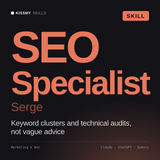
One job title, four named deliverables: keyword clusters, technical audits, content briefs and competitor gap analysis. The test for any source is whether you can tell what lands on your screen before you commit.
View Serge →4. Building your own
The fourth source is you. The best skill for your job is often the one that encodes how you work, not a generic version of your role. The process is less intimidating than it sounds, because the format is just Markdown:
- Pick one job, narrowly. Not "marketing" - something like reviewing paid search copy before it goes live.
- Write the description line first. This is what the model reads to decide whether the skill applies. A vague description either never triggers or triggers constantly.
- Write the method, not the personality. What gets asked before starting, in what order the work happens, what the output looks like, what the role refuses to do.
- Add one example of finished output. A single sample does more for consistency than another 300 words of instruction.
- Use it on real work for a week and fix what annoys you.
Claude will help you write it - describe your process out loud, have it draft the file, then edit hard. The first draft is usually too polite and too vague, and the editing is where the value appears.
If you are writing your own

$19
this skill
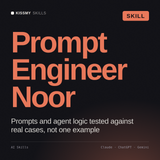
Instruction design, structure, failure testing and iteration, applied to your own drafts. Useful when the skill you actually need does not exist anywhere and you have decided to write it yourself.
View Noor →How to choose the right source
Four practical criteria, in the order they usually matter:
- How specific is the job? Common technical work is well covered for free. The narrower and more specialist the role, the faster free coverage runs out and the more a paid, curated skill earns its price.
- What is an hour of your time worth? Reading and judging ten community files takes an afternoon. If that afternoon is worth more than the file, the maths answers itself.
- Who carries the risk if the output is wrong? For personal work, unmaintained is fine. For anything client-facing or regulated, prefer a source with an owner, a version, and somewhere to complain.
- Can you see inside before you commit? The one non-negotiable. Any source, free or paid, that will not show you the method before you download is asking you to trust text you have not read. Walk away from that.
One more thing worth remembering: a skill does not make a weaker answer correct. It makes a good answer consistent. If the underlying reasoning would have been wrong, the best skill in any directory hands you the same wrong answer in a tidier format.
What to look for in a good Claude skill
The quality signals are consistent. A good skill is specific to one role rather than trying to do everything. It defines clear output formats, so you know what you will get. It states what it does and does not handle. And it is written for outcomes, not features - the description tells you what the skill produces, not how clever the file is. If a listing cannot tell you in one sentence what the skill does for you, that is a signal to keep looking.
How much do Claude skills cost
Prices sit in clear tiers. Simple prompt packs run from around the price of a coffee. Role-based skill files typically land in the mid-range, and senior or strategic skills sit at the top of the skill tier. Agents - which lead a whole task end-to-end rather than respond to prompts - are priced above skills. The useful way to think about it is cost versus the hours a configured specialist saves you each week, which makes most skills pay for themselves quickly.
How to use a Claude skill after you buy it
Buying is the easy part. After purchase you download the file, open Claude, and either load it into your Project Instructions or paste it as a system prompt. From that point every conversation in that Project behaves like the specialist. The same file works in ChatGPT or any AI chat that accepts custom instructions - so you are not locked into one tool.
What a good personal skill library looks like
The people who get the most out of this do not collect. They keep five to ten skills switched on, covering the jobs they actually repeat, and mix sources without ceremony: a couple of open source files a developer friend recommended, a few bought for roles nobody covers for free, one written for the thing only their company does.
Having forty skills installed is worse than having six. Every extra file is another description competing for the same request, and the ones you never use are just noise. Prune the same way you prune browser extensions.
The short version
Buy from a source that tests what it sells, pick a skill built for your specific role, and judge it on what it produces rather than how it is described. A good skill costs less than an hour of your time and saves you many. The KissMySkills marketplace organises tested Claude skills by role - marketing, sales, finance, HR, legal, development and more - as instant downloads that work with Claude, ChatGPT, or any AI chat.
Tested Claude skill files for every major role - instant download, no subscription. Works with Claude, ChatGPT, or any AI chat.
Browse all skills →Read the marketplace guide →Related reading
Best Claude skills marketplaces compared · Free vs paid Claude skills · Claude skills by role