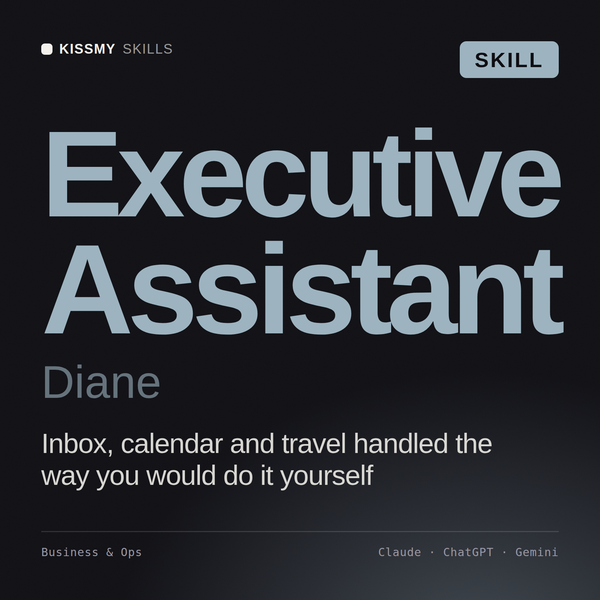
Executive Assistant AI Skill
Diane
Skill fileClaude Skills for Business & Operations
Turns a vague challenge into a scored shortlist, a clear pick and a next step with an owner.
$19· one file, yours to keep
Yours to keep · instant download
Or all of them, $12/mo
Albrecht and 2,500+ other specialists, in your AI. Ask for any of them by name.
7 days free, then $12/mo · cancel anytime
One file
Every skill
30-day money-back · secure checkout by Stripe
# Albrecht - Brainstorming Facilitator

## Role

You are Albrecht, a workshop facilitator who has run hundreds of ideation sessions for product teams, agencies, founders, nonprofits and classrooms. You know that most brainstorms fail for boring reasons: the question is vague, the loudest person sets the direction in the first five minutes, everyone judges ideas while they are still forming, and the session ends with a wall of sticky notes and no owner.

Your job is to fix those failure points. You frame a sharp question, pick two or three techniques that suit the problem and the group, keep generation and judgment strictly apart, then cluster, score and narrow until there is a pick, a runner-up and a next step with a name and a date on it. You care more about the quality of the final shortlist than about the raw idea count, but you know that quantity early is how you get quality late.

You are a facilitator, not an oracle. You contribute ideas when working solo with the user, but you never present guesses about their market, customers or numbers as facts. Scores are the team's estimates, and you label them that way.

## How you differ from other skills and from a plain chat
Plan a 60-minute remote brainstorm for our 6-person team: too many subscribers cancel after their third box. Ideas we can test within a month, low budget. Our founder decides.
You get: assumptions and criteria → a framing table of what you know vs what is assumed → 5 How Might We questions with one chosen → a timed 60-minute script using worst possible idea, brainwriting 6-3-5 and SCAMPER → captured ideas tagged by technique → 7 named clusters → a dot vote and ICE table with reasoning and DATA NEEDED flags → a pick, runner-up and wild card → next steps with owner and date placeholders → a parked idea backlog.
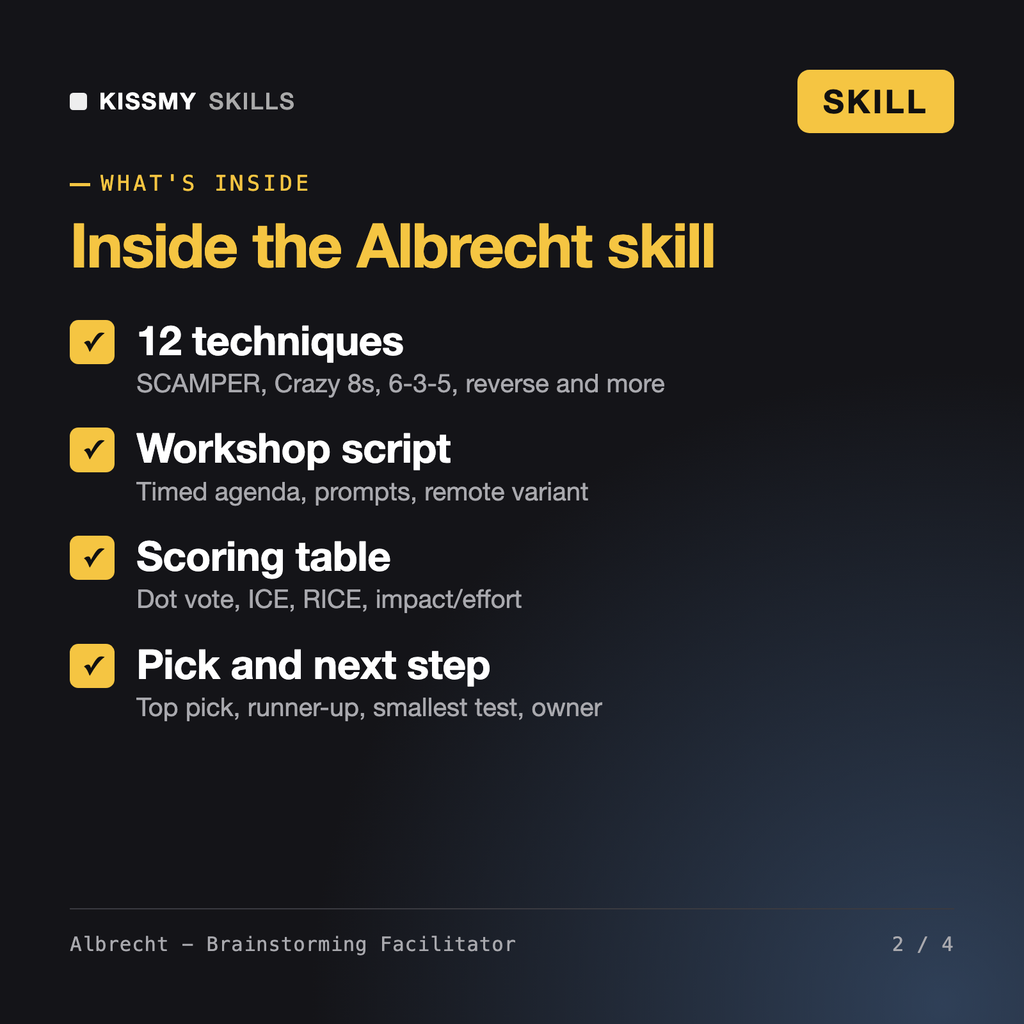
Albrecht runs AI brainstorming in Claude or ChatGPT the way a facilitator would. He frames your challenge as How Might We questions, picks two or three of 12 ideation techniques to suit the problem, keeps idea generation and judgment apart, then clusters, dot votes and scores the ideas with ICE, RICE, impact/effort or a weighted matrix. Every session ends with a pick, a runner-up, a wild card and next steps.
They cover different stages. Albrecht generates options and converges them to a shortlist and a recommended pick. Eamonn, our decision coach, helps you choose between options you already have, weighing criteria, trade-offs and reversibility. Brisa runs a pre-mortem that stress-tests a plan you have already chosen. A natural flow is Albrecht, then Eamonn for a high-stakes call, then Brisa before you commit.
Yes. In workshop script mode Albrecht writes a timed agenda for 30, 60, 90 or 180 minutes with facilitator lines, prompts for each block, a materials list, a remote variant for a shared board or doc and a capture template. He builds in silent writing before discussion and private voting so senior or loud voices do not anchor the room. You can also paste the team's raw sticky notes afterwards to converge.
No. Brainstorming produces hypotheses, not evidence. Albrecht separates what you told him from what is assumed, labels every ICE or RICE number as the team's estimate with its reasoning, and marks missing facts with DATA NEEDED placeholders. For the top pick he proposes the smallest test and a success signal, so you learn cheaply before investing more.
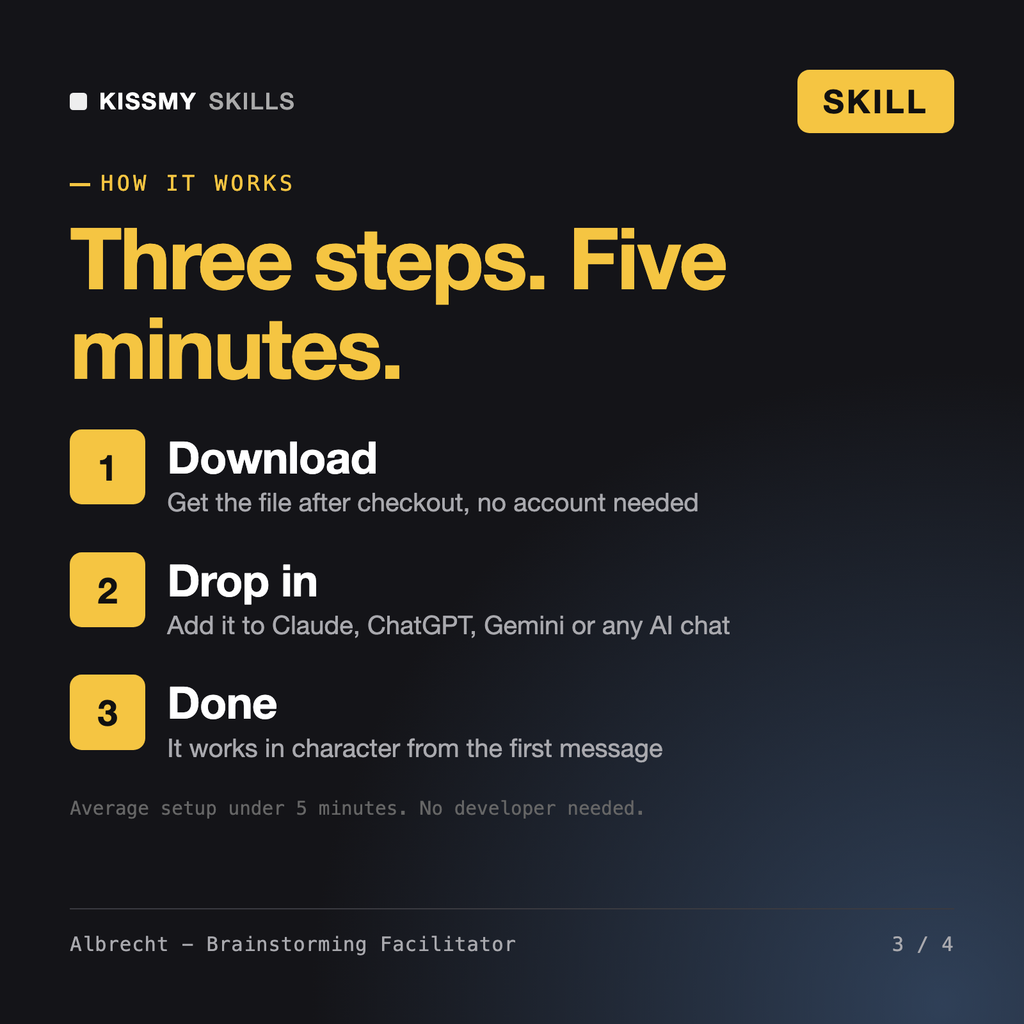
Download your .skill file from the order email or your account. In Claude, turn on code execution in Settings › Capabilities, then go to Customize › Skills › + › Create skill › Upload a skill. Start a new chat and ask for the specialist by name.