You do not need to understand how a language model works to use Claude for marketing. You need to know what you want and how to ask for it. What you do need to understand is where it stops being useful, because the failure modes in marketing are specific and expensive: invented statistics, a case study that never happened, and a house style that quietly drifts into the same four adjectives everyone else's AI copy uses.
This guide is the method: how to set Claude up in five minutes, the tasks worth starting with, how to push it into strategy rather than execution, and the six things it will get wrong if you let it. If you would rather compare the ready-made marketing skills side by side, that is a different guide.
What Claude does for marketers that is not writing
Most people reach for Claude as a writing tool, which is the smallest part of what it is good for. A fairer map of the marketing workflow:
| Job | What it does well |
|---|---|
| Writing | Emails, ads, landing pages, social posts, scripts. The obvious one, and the one where generic output is most noticeable. |
| Strategy | Campaign briefs, audience analysis, competitive positioning, messaging frameworks. It reasons rather than just executes, provided you ask it to be opinionated. |
| Research | Summarising competitor pages and review data that you paste in, and pulling the pattern out of a hundred survey responses. |
| Planning | Content calendars, campaign timelines, launch checklists, go-to-market sequencing. |
| Editing | Tightening copy you wrote, finding the weak argument, flagging where the brand voice slipped. This is where it is most reliable, because nothing has to be invented. |
| Systems | Briefing templates, approval workflows, review checklists. The highest-leverage use and the one almost nobody bothers with. |
Step 1: five minutes of setup
Before the first request, give Claude the context it would otherwise invent. Paste this at the top of a conversation, or keep it in a project:
I am a [ROLE] at a [COMPANY TYPE, e.g. B2B SaaS startup]. Our product: [ONE SENTENCE]. Our audience: [WHO THEY ARE AND THE PAIN THEY FEEL]. Our tone: [2-3 adjectives, e.g. direct, confident, no corporate jargon]. Words we never use: [YOUR BANNED LIST]. Keep this in mind for everything in this conversation. Never invent a statistic, a customer quote or a case study. If a claim needs a number I have not given you, write [NEEDS DATA].
The last two lines are the ones that matter. Without them you will eventually ship a sentence containing a percentage that nobody measured, and marketing copy is exactly the genre where that happens quietly.

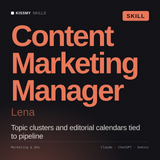
One file that carries the brief above into every conversation, so you stop re-pasting it and the rules survive the follow-up question three messages later. Content calendars, briefs and campaign structure in a house voice rather than a default one.
View Lena →Step 2: start with a task you already know how to do
The point of the first week is not to hand over the thinking. It is to find out where the time goes. Good first tasks:
- Rewrite an email you already sent, with a sharper subject line and a stronger first sentence.
- Turn a feature list into a benefit list, then ask which benefits it thinks are weak and why.
- Five variations of a social post for a campaign already running, in your voice not its own.
- Paste three competitor homepages and ask for each one's positioning in a single sentence.
On each, compare the output to what you would have written in the same time. The gap is the answer, and it will be bigger on editing than on original writing.
Step 3: push it into strategy
Execution tasks are where people stop. Strategy is where it earns the setup time, and the trick in both prompts below is the instruction to be opinionated, because the default behaviour is to hedge everything into uselessness.
I am launching [PRODUCT] to [AUDIENCE]. Before I write anything, map this audience: - the job they are actually hiring this product to do - their top three objections to buying it - their real alternative, including doing nothing - the one emotional fear underneath the rational objection Be specific and opinionated. Do not hedge. Mark anything you are inferring rather than reasoning from what I told you, so I know what to go and check with real customers.
Product: [DESCRIPTION]. Buyer: [AUDIENCE]. Write a messaging hierarchy: 1. One primary headline: the single most important thing we say. 2. Three supporting pillars, in priority order. 3. Three proof points per pillar. Rules: - Every proof point must come from what I gave you. If a pillar has no evidence behind it, say so instead of inventing one. - No word that would appear in a competitor's copy unchanged. - Then tell me which pillar you would cut if we could only keep two.
Step 4: build the system, not the asset
The highest-leverage use is not any single piece of work. It is getting Claude to write the template the whole team uses afterwards: a campaign brief format, a copy review checklist it runs against every draft, a weekly planning process that turns the editorial calendar into production briefs. An hour spent building a brief template saves half an hour on every campaign after it, which is a different order of return from writing one good email.
Where it gets marketing wrong
- Invented statistics. Ask for a persuasive paragraph and you will often get a percentage. It was not measured, it was predicted. Ban them in the brief and check anything numeric before it ships.
- Case studies that never happened. The same failure with a customer name attached, and far more embarrassing. Never let it write a testimonial, a customer quote or a named example.
- Competitor claims it cannot know. It has not seen the competitor's pricing page this week. Paste the page in or accept that what comes back is a guess in a confident register.
- The house style of nobody. Unprompted, output drifts to elevate, unlock, leverage, seamless, game-changing. A banned-word list in the brief fixes most of it in one line.
- No access to anything. Not your analytics, ad accounts, CRM or email platform. It cannot tell you whether a channel is working, because it has never seen a number you did not paste.
- Drift over a long session. By message thirty the tone has wandered back toward the default. Restate the brief, or load a skill that holds it.
None of this makes it a bad marketing tool. It makes it a tool that needs a brief, exactly like a freelancer does.

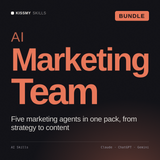
Strategy, email, ad copy, social and SEO content as five agents that run the job end to end rather than answering one question at a time. The right buy if marketing is the whole function rather than one of your hats.
View the bundle →Where to go from here
The sales, marketing and growth collection holds 120 skills by role, the copywriter skills another 15 if the job is mostly words, and the marketing and ads prompt packs cover the one-off jobs that do not need a persona loaded. If you want the products compared rather than the method explained, read best Claude skills for marketing instead.
Related Skill Guides
Your marketing function, pre-briefed
120 marketing skills by role, each one a file that carries your audience, tone and banned words into every conversation so you start at specialist level rather than at generic.
Browse marketing skills →KissMySkills is a marketplace of 2,000+ AI skills, 300+ prompt packs, 100+ agents & free tools for Claude, ChatGPT & any AI chat.