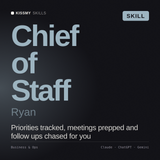
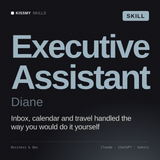
Four products cover executive-office work at KissMySkills: Ryan - Chief of Staff ($19) for board packs, OKRs and decision memos; Diane - Executive Assistant ($19) for inbox triage and meeting prep; Owen - Operations Manager ($19) for SOPs and cross-team process; and William ($39), an agent that walks you through EA workflows end to end. If you only buy one, buy Ryan: headline-first decision-memo structure is the thing an unguided chat is worst at producing. None of them can read your email, calendar or CRM - you paste, they process.
Updated September 2026. Prices below were read from the live product pages on the day of writing; the product page is always the authority if they ever drift apart. Browse all Claude skills by role.
Which one should you buy?
| Product | Buy it for | Price |
|---|---|---|
| Ryan - Chief of Staff | Board packs, OKR drafts, all-hands scripts, one-page decision memos | $19 |
| Diane - Executive Assistant | Turning pasted email into an action list, meeting briefs, agendas, polite declines | $19 |
| Owen - Operations Manager | SOPs with exception paths, RACI matrices, handoff docs, escalation rules | $19 |
| William - AI Executive Assistant Agent | The same EA work, but step-by-step prompted - if you don’t want to learn how to drive it | $39 |
Ryan - what does a chief-of-staff skill actually produce?
Four artefacts, in practice:
- The one-page decision memo. Recommendation in the first line, then the evidence, then the two options rejected and why, then what new information would change the recommendation. That last section is the one people leave out and the one boards ask about.
- Board pack sections. Headline, the three numbers that moved, what you are asking the board to approve, and the risks with owners against them. It structures; you supply the figures.
- OKR drafts. Objective plus key results, and it catches the standard error - key results written as activities ("launch the new onboarding flow") rather than outcomes ("cut day-7 drop-off from 41% to under 30%").
- All-hands and exec-update narrative. Bad news first, context second, ask third.
What you have to give it: the real numbers, the actual constraint, and who makes the call. Hand it a topic with no figures and it writes a well-shaped memo about a decision it does not understand - and it will format a placeholder number as confidently as a real one.

Enforces headline-first structure: the recommendation on line one, the rejected options and the trigger that would change your mind underneath it.
View Ryan →Diane - what does the executive assistant skill do?
Start with what it does not do, because this is the most common disappointment: Diane cannot read your inbox or your calendar. There is no mailbox connection. The workflow is that you paste a block of email or a thread and it comes back with an action list - what needs a reply from you personally, what can be delegated, what is informational, and what has a deadline attached.
Given that, the useful outputs are: meeting briefs assembled from the material you paste in, agendas with time boxes and a decision named for each item, drafted replies in your register, and declines that close the door without burning the relationship. Also travel itineraries reconstructed from a pile of confirmation emails, which is a genuinely tedious job it does well.

Paste the thread, get back a triaged action list, a meeting brief and a draft reply. No mailbox access - it works on what you give it.
View Diane →Owen - when do you need the operations manager instead?
When the problem is that the work is undocumented rather than undecided. Owen writes SOPs in the shape that survives contact with reality: owner, trigger, numbered steps, and - the part most SOPs omit - the exception path for when a step fails and who to escalate to. Also RACI matrices, handoff documents between teams, and process maps with the decision points marked.
Rule of thumb: if the sentence starts "we need to decide", that is Ryan. If it starts "nobody knows how we do this", that is Owen.

SOPs with owner, trigger, steps and an exception path; RACI matrices; team handoff docs; escalation rules with names against them.
View Owen →Skill or agent - what is the difference?
A skill configures the role and then waits for you to direct it. You still decide what to ask for and in what order. An agent bundles the same role with an activation prompt that runs the workflow, asking you for one input at a time until the artefact is finished.
Buy the skill if you already know what a good brief looks like. Buy William ($39) if you would rather be asked questions than have to think up prompts. It is three dollars more than Diane for the same underlying job, so the decision is not really about money: it is whether you want to drive or be driven. If you have never written a brief for an assistant, human or otherwise, the agent earns its three dollars in the first session.
How do you install these?
Each one is a ZIP with a SKILL.md file at the root. In the Claude desktop app: Customize → Skills → +, upload the ZIP, toggle it on. Claude reads the SKILL.md and shows a summary before you enable it. You can have several installed and switch them on and off independently.
Two prerequisites, and people usually only know about one. The one that catches most people is code execution, which you turn on as Code execution and file creation under Settings → Capabilities. If the menu is greyed out, that switch is usually the reason, and on Team and Enterprise it may be an owner-level setting rather than yours to flip. Plan availability is the other: Anthropic's help centre currently lists Skills on Free, Pro, Max, Team and Enterprise, while its Academy tutorial lists Pro, Max, Team and Enterprise, so check Settings → Capabilities for your own account rather than taking either page's word for it.
Where there is no Skills menu, or in ChatGPT or Gemini, there is no upload step at all: open SKILL.md in a text editor and paste its contents into custom instructions. You lose the on/off toggle and the automatic triggering; the behaviour is the same.
What these skills will not do for you
They have no access to anything. Not your email, calendar, Slack, CRM, drive or ticketing system. Everything they work on is something you pasted or attached. Every "AI chief of staff" article that implies otherwise is describing a different category of product.
They do not know your numbers. A board pack is only as good as the figures you supply. Ask for one without data and you will get a well-formatted document containing invented placeholders that read exactly like real results.
They have no read on your politics. A skill cannot tell you which stakeholder will quietly kill the plan, because it has never met them. Anything it says about a named person’s motivation is fabrication.
They do not remember. A skill is a set of standing instructions, not memory. Context you gave it last Tuesday is gone unless you keep it in a project or paste it again.
Your name goes on the output. The failure mode that costs most is a confident sentence you did not supply and did not check. Read board and OKR drafts line by line for facts you cannot source.
In summary
Decisions and board-level documents → Ryan ($19). Daily inbox and meeting load → Diane ($19). Undocumented process → Owen ($19). Want to be prompted through it → William ($39). All are ZIP uploads for Claude with code execution switched on, with a paste-in fallback wherever the Skills menu is unavailable and in ChatGPT and Gemini, and a 30-day money-back guarantee. Browse the rest in business, consulting and operations skills.
Related Guides
Ryan - Chief of Staff AI Skill
If you only buy one of the four, this is it. Headline-first decision memos, board pack sections, OKRs written as outcomes rather than activities, and the rejected options written down where a board can see them.
KissMySkills is a marketplace of 2,000+ AI skills, 300+ prompt packs, 100+ agents & free tools for Claude, ChatGPT & any AI chat.