AI agents for e-commerce are pre-built AI assistants that handle specific store tasks - writing product listings, planning ad campaigns, drafting email flows, and answering customer questions - without you writing prompts from scratch. You choose an agent for the job, give it your product and brand details, and it returns store-ready output in minutes. For lean online stores, agents add capacity without adding headcount.
This guide explains what e-commerce AI agents do, the tasks they handle best, how to put them to work, and which ones to start with.
What is an AI agent for e-commerce?
An AI agent is an AI assistant that has been given a clear role, a set of instructions, and a repeatable workflow for one job. A general chatbot waits for you to explain everything every time. An agent already knows how to do the task - you just supply the specifics. For an online store, that means you can hand off a listing, a campaign, or an email sequence and get back something usable, on brand, and structured the right way.
If you are new to the idea, our explainer on how to build an AI agent and the difference between agents, skills, and prompts are good starting points.
The e-commerce tasks AI agents handle best
Product listings and SEO copy
Writing dozens of product descriptions is slow and repetitive - the perfect job for an agent. It can produce consistent, keyword-aware listings and category copy at scale.
Advertising and campaigns
Ad copy, headlines, and campaign structure across search and social. An agent like Cecil — AI Ad Copy Agent drafts variations you can test quickly.
Email and retention
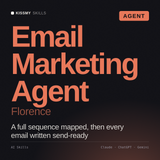
Welcome flows, abandoned-cart sequences, and promotional campaigns. Florence — AI Email Marketing Agent turns a goal into a full sequence.
Social content
Captions, content calendars, and post ideas that match your brand voice - see Beatrice — AI Social Media Agent.
Customer support
Drafting clear, on-brand answers to the questions your store gets over and over. Our guide on using AI agents for customer support covers this in depth.
How to put an AI agent to work in your store
- Pick the bottleneck. Choose the task that eats the most time or that you keep putting off - often product listings or ads.
- Choose the matching agent. Each agent is built for one job, so match the agent to the task.
- Feed it your details. Give it product facts, audience, brand voice, and any offers. The more specific you are, the better the output.
- Review and refine. Treat the first draft as a strong starting point. Ask for one improvement at a time.
- Reuse it. Once an agent works for one product or campaign, run it again for the next. That repeatability is where the time savings compound.
Where to start
If you sell physical products, a launch-focused agent gives you the fastest visible win because it touches listings, keywords, and go-to-market in one pass. From there, add an ad-copy or email agent to cover acquisition and retention. You can buy agents individually, or get a full set at a lower price with the Marketing Agent Bundle. For a wider view, see our guide to AI agents for small business.
Frequently asked questions
What is an AI agent for e-commerce?
An AI agent for e-commerce is a pre-built AI assistant with a defined role, instructions, and workflow for a specific store task, such as writing product listings, planning ad campaigns, drafting email flows, or handling customer questions. You give it your details and it produces store-ready output, instead of you building the prompt from scratch each time.
Do AI agents replace an e-commerce team?
No. They handle repetitive, time-consuming work like drafting copy, structuring campaigns, and answering common questions, which frees your team for strategy, merchandising, and relationships. Think of an agent as leverage for a small team rather than a replacement for people.
Which e-commerce tasks are best for AI agents?
The best fits are high-volume writing and planning tasks: product descriptions, category and SEO copy, ad copy and campaign structure, email and SMS flows, social captions, and first-response customer support. Anything you do repeatedly to a template is a strong candidate.
Do I need to know how to code to use an AI agent?
No. The agents on KissMySkills are written in plain language and designed for non-technical store owners. You paste the agent into a supported AI assistant, answer its questions, and it does the work.
How much do AI agents for e-commerce cost?
Individual agents on KissMySkills start at $49, and category bundles are $99 for a set of five. That is a one-time purchase, not a subscription, which makes agents an affordable way for small stores to add capacity.
AI agents will not run your store for you, but they remove the repetitive drafting and planning that slows small teams down. Start with one bottleneck, prove the time savings, and expand from there.
Prefer to browse? See every option in the AI agents collection.