生成式 AI 廣告:以 10 倍速度製作更優質的廣告

為什麼廣告創意是付費行銷中最大的瓶頸

擁有最佳 ROAS 的付費媒體團隊,測試的創意變體比競爭對手更多 - 不是因為直覺更好,而是測試更多。測試速度的瓶頸一直都是創意製作。人類創意團隊每週產出 5-10 個變體。AI 輔助團隊則能產出 30-50 個,同時測試更多角度與受眾。

填滿創意測試管線
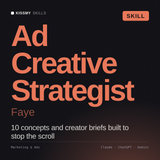
Faye - 廣告創意策略師 AI Skill
$29這項 Skill 對比 $85廣告創意策略師/hr

專為解決上述確切瓶頸而打造:每份簡報產出數十個概念草圖與角度變體,讓測試速度而非創意產能決定廣告成效上限。

查看 Faye →

生成式 AI 在廣告中的作用

文案生成:標題、主要文字、CTA 變體

搭配 advertising Skill 檔案的 Claude 能產出結構化廣告文案套件 - 包含多個採用不同心理機制的標題、針對不同受眾的主要文字變體,以及針對不同轉換目標最佳化的 CTA 選項。一份指定優惠方案、受眾及 4 個待測試角度的簡報,可在 10 分鐘內產出完整的 RSA 或 Meta 廣告套件。

創意概念生成

文案之前先做概念:鉤子、角度、故事框架。生成式 AI 每週只需根據一份結構化簡報,就能產出 20-30 個創意概念草圖。人類創意總監選出最強的概念,再向 AI 圖像工具或製作團隊說明勝出方案。

大規模在地化與受眾變體

5 個受眾區隔 x 3 個市場 x 4 種廣告格式 = 60 個廣告變體。沒有 AI:60 次獨立的文案撰寫工作階段。有了 AI:一份主簡報、一次 Claude 工作階段,依序產出 60 個變體。過去需要翻譯公司的在地化工作,如今只需設定一個 prompt 參數。

生成式 AI 廣告工作流程

  1. 向 Claude 提供簡報 - 優惠方案、受眾、要測試的 4 個角度、字數限制、禁用詞組。
  2. 製作文案套件 - 每個角度各製作一套完整 RSA 或 Meta 廣告組。4 個角度 = 4 套完整測試組。
  3. 載入平台 - Google RSA、Meta Advantage+。讓平台 AI 處理變體測試。
  4. 兩週後分析 - 哪個角度勝出?哪種機制表現最佳?將學習成果納入下一份簡報。

這個閉環會帶來複合式改善。每個週期都建立在先前有效的方法之上。KissMySkills Advertising Skill 檔案會將 Claude 設定為直接回應型文案撰稿人,專門執行這套工作流程。可於 KissMySkills.com 取得。

準備好將這套方法付諸實踐了嗎? 瀏覽適用於 Claude & ChatGPT 的行銷與廣告 Skill,或探索所有 Claude Skillprompt 資料庫

常見問題

Why is ad creative the biggest bottleneck in paid marketing performance?+

Paid media teams with the best ROAS test more creative variants than their competitors — not better instincts, more tests. The bottleneck to testing velocity has always been creative production capacity. A human creative team produces 5–10 variants per week, limiting how many angles, audiences, and psychological mechanisms can be tested simultaneously. An AI-assisted team produces 30–50 variants per week, running more tests in parallel and accumulating performance learning faster. The performance gap compounds every cycle because the higher-testing team's data advantage grows continuously.

What does generative AI actually do in advertising creative production?+

Three functions: copy generation (Claude with an advertising skill file produces structured ad copy packs — multiple headlines with distinct psychological mechanisms, primary text variants for different audiences, and CTA options for different conversion goals — in under 10 minutes from a structured brief); creative concept generation (producing 20–30 creative concept sketches per week from a single brief, with human creative directors selecting the strongest concepts before briefing production); and localisation and audience variants at scale (5 audience segments multiplied by 3 markets multiplied by 4 ad formats produces 60 variants from one master brief in a single Claude session, versus 60 separate copywriting sessions without AI).

What is the generative AI advertising workflow for maximum testing velocity?+

Four steps run as a closed loop: brief Claude with the offer, audience, four angles to test, character limits, and forbidden phrases; produce a complete copy pack per angle — a full RSA set or Meta ad set for each of the four angles, producing four complete test sets from one session; load the variants into Google RSA or Meta Advantage+ and let platform AI handle variant testing at delivery; then analyse at two weeks to identify which angle and psychological mechanism won, and feed that learning directly into the next brief. Each cycle builds on what performed, producing compound improvement in creative quality and ROAS over time.

How does AI handle localisation and multi-audience ad variant production?+

Localisation and audience segmentation that previously required multiple copywriting sessions or a translation agency become prompt parameters in a single Claude session. A campaign requiring 5 audience segments, 3 markets, and 4 ad formats — 60 variants in total — is produced from one master brief in sequence rather than 60 separate production tasks. The offer, tone adjustments, and market-specific considerations are specified in the brief; Claude applies them systematically across every variant. Production time drops from days to under an hour for the same variant volume.

Why does the generative AI advertising workflow produce compound improvement over time?+

The closed-loop structure — brief, produce, test, analyse, re-brief — means every cycle's performance data directly informs the next cycle's creative strategy. Which psychological mechanism outperformed, which audience responded to which angle, which CTA drove higher conversion — all of this feeds back into the next brief as explicit direction rather than intuition. Teams running this loop weekly accumulate a growing body of account-specific performance intelligence that generic creative teams working without this data structure cannot replicate. After six months, the creative strategy is informed by hundreds of real tests rather than a handful of instincts.

~/get-started

實用的 Skills。不說空話。

瀏覽商店中的每個技能、prompt 套件和 agent。

瀏覽所有技能 →或試試免費工具