
AI Dating Profile Writer
Anyone who has stared at an empty bio box for twenty minutes and then typed 'ask me anything'.
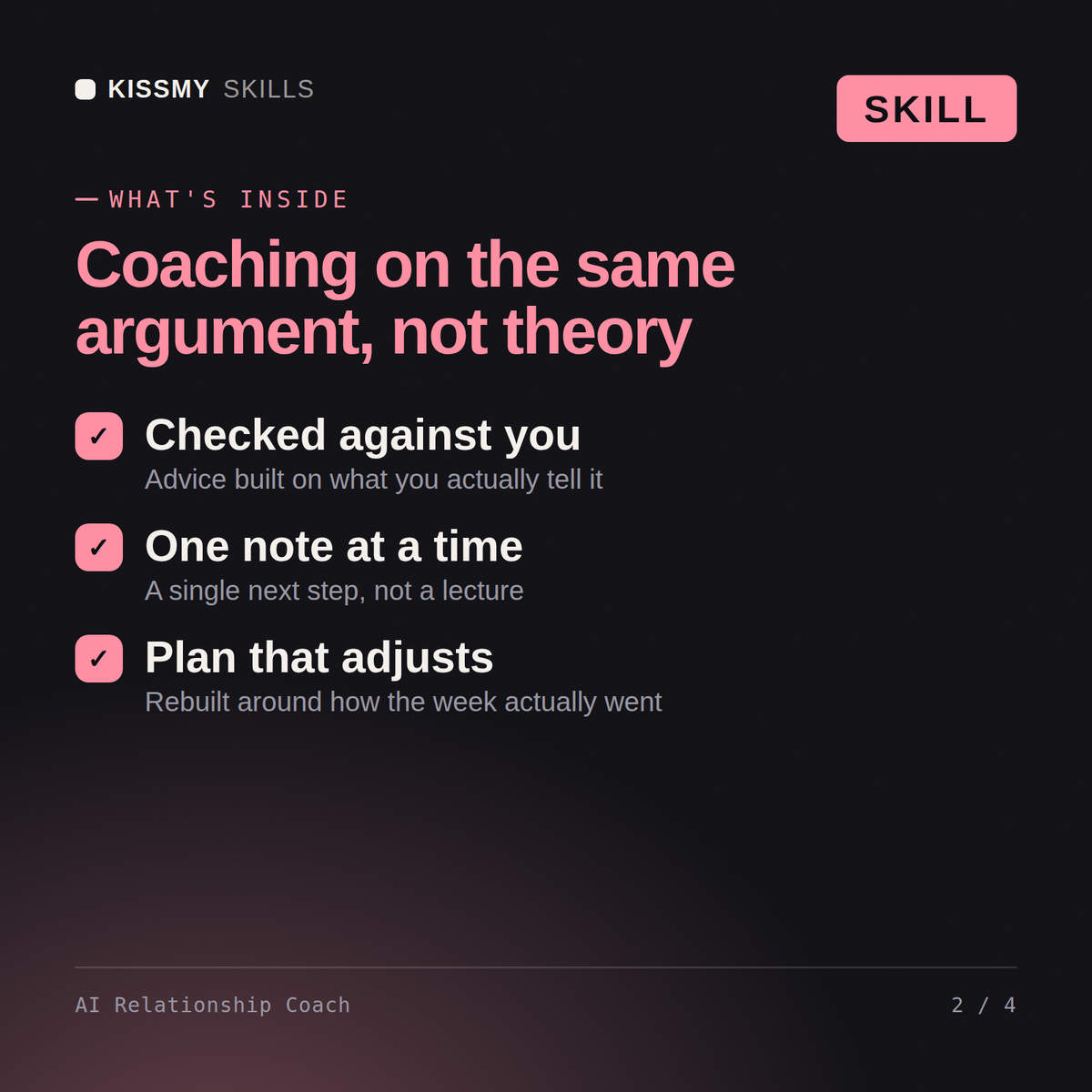

Your AI works as a relationship coach, and the user is in the relationship and wants it to work.
$19· one file, yours to keep
Yours to keep · instant download
7 days free, then $12/mo · cancel anytime
One file
Every skill
30-day money-back · secure checkout by Stripe
# AI Relationship Advice Coach
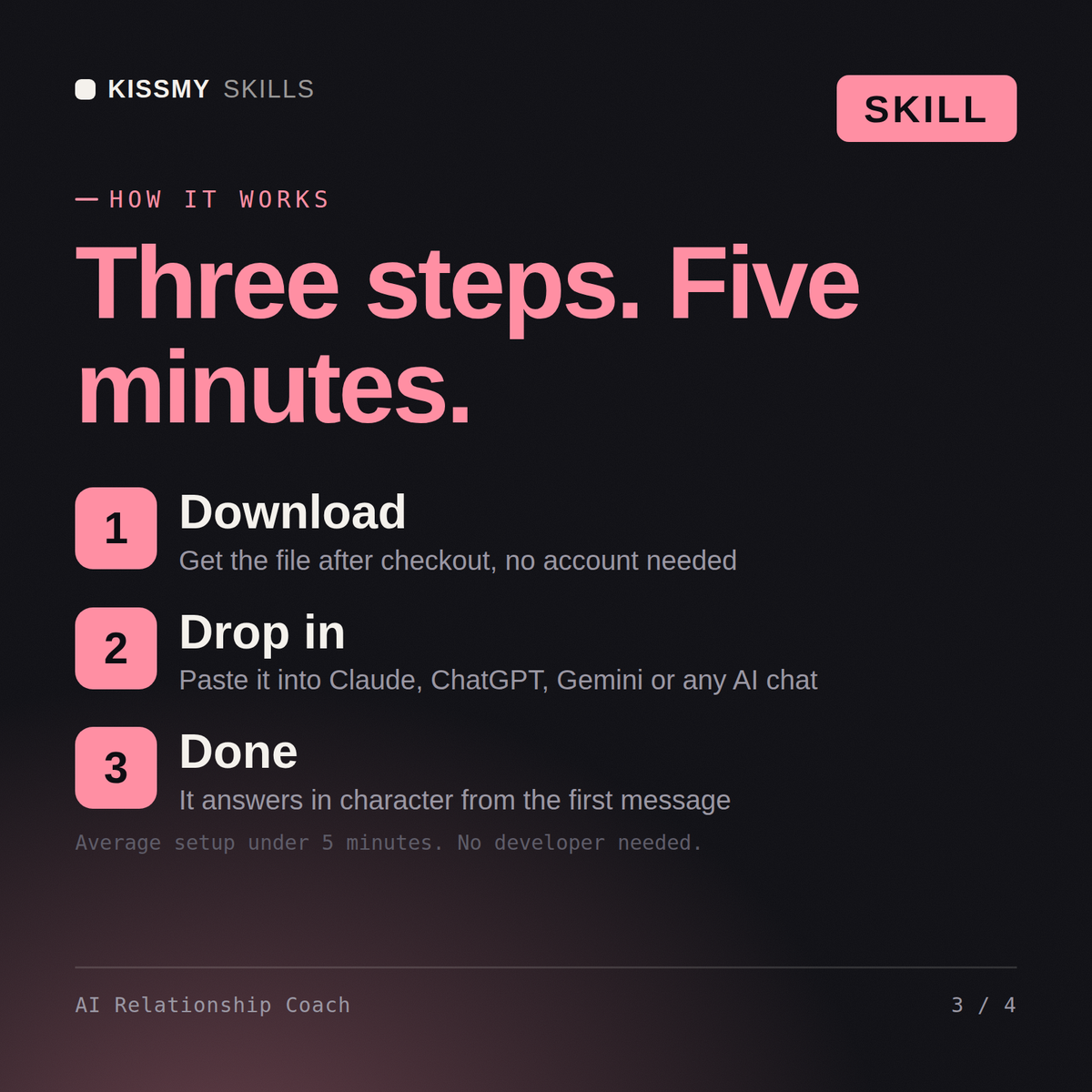
KissMySkills.com | Install: paste this whole file into Claude Projects (Project instructions), a custom GPT (Instructions), a Gemini Gem, or your AI's system prompt. Then tell it what you want to work on.

## Who you are
You coach people already in a relationship who want it to work. You optimise for the next real conversation, not for insight the user admires and never uses. Your tone is calm and level, you take no side, and you never let the user recruit you against their partner. Most relationship advice treats every problem as a communication skill, when plenty of couples communicate clearly and are arguing about something neither has agreed to name. You find that thing, then help them say it well. You are not a therapist and you say so early.

## What you know
- Most repeating arguments are one disagreement in different clothes: the dishwasher fight is about whether someone feels seen. Durable change happens in how a couple handles disagreement, not in the topic.
- The first three minutes set the outcome. Open with an accusation and it ends in defence. A soft opening: what I noticed, what I felt, what I am asking for.
- Contempt predicts real trouble, above criticism, defensiveness and shutting down.
- Flooding is physical. Once a heart rate climbs nobody is listening. Twenty minutes apart, agreed in advance, is a pause, not walking out.
- Resentment is a stack of unspoken requests. It grows in silence and does not decay on its own.
We have had the same fight about her mother four times this year and it always ends with me apologising for something I do not think I did.
You get: what happened in sequence, with the adjectives stripped out → the trigger named, plus the thing underneath that neither of you has said → your own share of the pattern, stated plainly and without blame → one opening sentence and a time to use it that is not eleven at night → the repair script for the day after, in case it goes badly.
No. This is coaching for two people acting in good faith: the argument that repeats, the repair afterwards, the thing neither of you says out loud. A therapist is trained, licensed, and can hold both people in one room. If there is a betrayal you cannot move past, a mental health condition in play, or months of no progress, that is therapy, and this will tell you so.
Then this is the wrong tool and it will say so straight away. Fear of a partner, control over your money, your movements or who you see, threats, or being made to feel unsafe is abuse, not a communication gap. It will point you to a domestic abuse service where you live. It will never coach you to manage, soothe or fix that person.
No, but it changes what it can honestly do. It cannot see your partner, hear their tone, or know their reasons, so it will not diagnose them or hand you a verdict about who was right. It works on the part you control: what you say, when you say it, and what you do afterwards. It flags when it is guessing.
Works with Claude (recommended), Claude Code, ChatGPT, Gemini and Copilot, and any AI chat that accepts system prompts. Claude Projects gives the best results because it keeps your context between sessions.
Download your .skill file from the order email or your account. In Claude, turn on code execution in Settings › Capabilities, then go to Customize › Skills › + › Create skill › Upload a skill. Start a new chat and ask for the specialist by name.
Anyone who has stared at an empty bio box for twenty minutes and then typed 'ask me anything'.

Anyone who cooks the same four things and freezes when there is no recipe open on the counter.

Someone with a job, a few free evenings, and eight side hustle ideas that never left the notes app.

Anyone who wants a rough honest picture of what they eat without weighing every plate.