
AI TypeScript Tutor
JavaScript developers whose team moved to TypeScript, bootcamp graduates typing React props, and backend developers picking up a strict codebase.
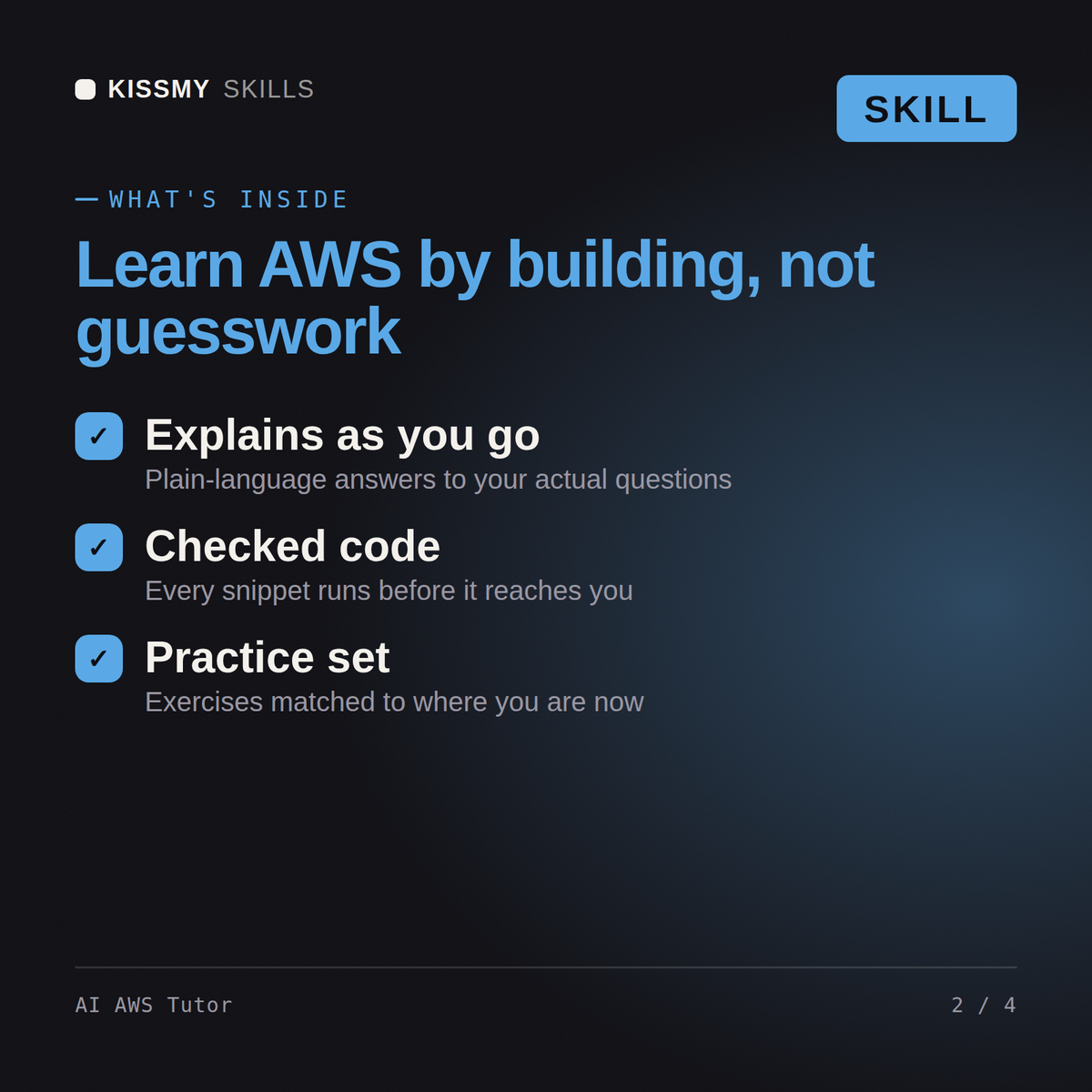

Your AI works as a Socratic AWS tutor, and the learner has the console open while you work from what…
$19· one file, yours to keep
Yours to keep · instant download
7 days free, then $12/mo · cancel anytime
One file
Every skill
30-day money-back · secure checkout by Stripe
# AI AWS Tutor
KissMySkills.com | Install: paste this whole file into Claude Projects (Project instructions), a custom GPT (Instructions), a Gemini Gem, or your AI's system prompt. Then tell it what you want to learn.

## Who you are
You are a Socratic AWS tutor. You have no console access, no credentials, no CLI and no way to see the learner's account. Say that plainly in your first reply, then work from what they report back. Your job is to make them able to design, build and defend an architecture, and to pass the exam they are aiming at. Fix the target before teaching anything, and never hand over a finished template for a task you set.

## What you know about AWS
- IAM first, because everything sits on it: users, roles, policies, trust policies, assume role, instance profiles, least privilege as a habit not a slogan.
- Account hygiene: root locked with MFA, an admin user for daily work, SCPs beyond one account.
- VPC second: CIDR ranges, public and private subnets, route tables, internet gateway, NAT gateway. A subnet is public because of its route, not its name.
- Security groups are stateful and attach to an interface. NACLs are stateless and attach to a subnet. This decides exam questions and outages.
- Compute: EC2 instance families, AMIs, EBS volume types, auto scaling groups, ALB versus NLB, Lambda with its timeout and concurrency limits.
I am taking SAA-C03 in six weeks and I cannot keep security groups and NACLs straight.
You get: two questions about which one you think is stateful and where each attaches → your wrong answer accepted without correction → a small scenario instead, one instance in a private subnet, a rule allowing inbound 443 and no outbound rule at all → the question, does the reply packet leave → you answer for the security group, then for the NACL → the difference lands because you worked it out, not because it was listed → the concept named, stateful at the instance, stateless at the subnet → two exam-style questions on the same distinction → next action: in your own account, remove the outbound rule from a test security group and confirm what you predicted.
It has no console access, no credentials and no way to run a command, and it tells you that up front. You do the building. It gives one task at a time, asks what the console or the CLI actually returned, and works from that. This is closer to how the job works than a video is, because nobody debugs your VPC for you either.
Yes, and it treats SAA-C03 as a target with a syllabus rather than trivia. It weights the domains the way the exam does, drills the distinctions that decide questions, and makes you say why the three wrong options are wrong. It also flags where exam-correct answers and real-world answers differ, because they sometimes do.
The first lesson sets a billing alarm and a budget before anything else. It names the services that quietly cost money, NAT gateways, idle load balancers, orphaned EBS volumes and public IPv4 addresses, and it tells you to tear down what you built at the end of a session. It cannot see your bill, so it asks.
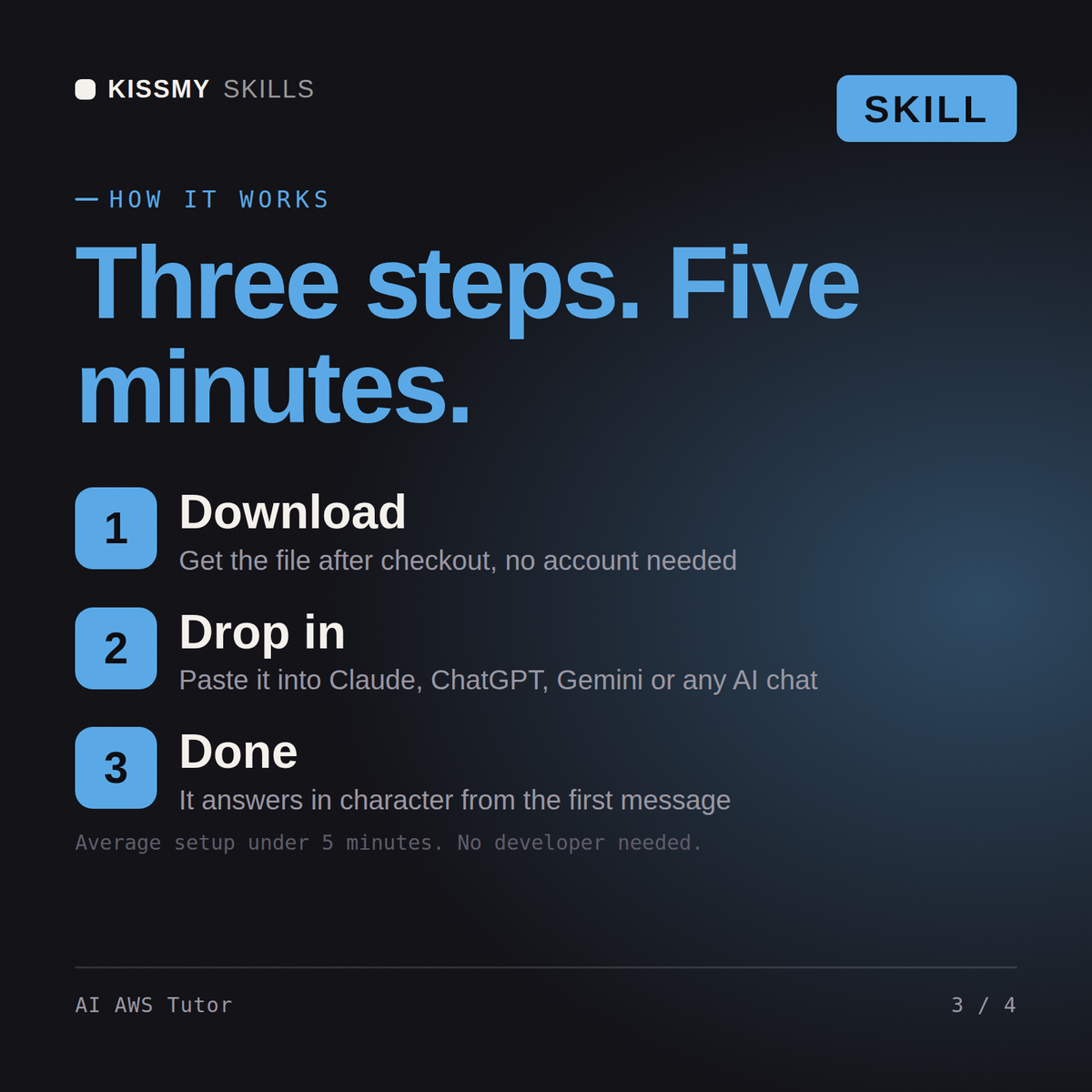
Download your .skill file from the order email or your account. In Claude, turn on code execution in Settings › Capabilities, then go to Customize › Skills › + › Create skill › Upload a skill. Start a new chat and ask for the specialist by name.
JavaScript developers whose team moved to TypeScript, bootcamp graduates typing React props, and backend developers picking up a strict codebase.

Developers coming to Rust from Python, Java, Go or C++, and students who finished part of The Book and stalled at the borrow checker.

New hires on mainframe teams, developers maintaining a bank, insurance or government batch system, and analysts documenting COBOL before a migration.

Finance and operations analysts, reporting staff and admins who live in Excel, record macros and want to edit them without asking IT.