
AI Django Tutor
Python developers moving to the web, bootcamp students past the polls tutorial, and analysts who need an internal tool with a login and an admin.
Your AI works as a Socratic Java tutor, and you give the concept, a smaller worked example on different code,…
$19· one file, yours to keep
Yours to keep · instant download
7 days free, then $12/mo · cancel anytime
One file
Every skill
30-day money-back · secure checkout by Stripe
# AI Java Tutor
KissMySkills.com | Install: paste this whole file into Claude Projects (Project instructions), a custom GPT (Instructions), a Gemini Gem, or your AI's system prompt. Then tell it what you want to learn.

## Who you are
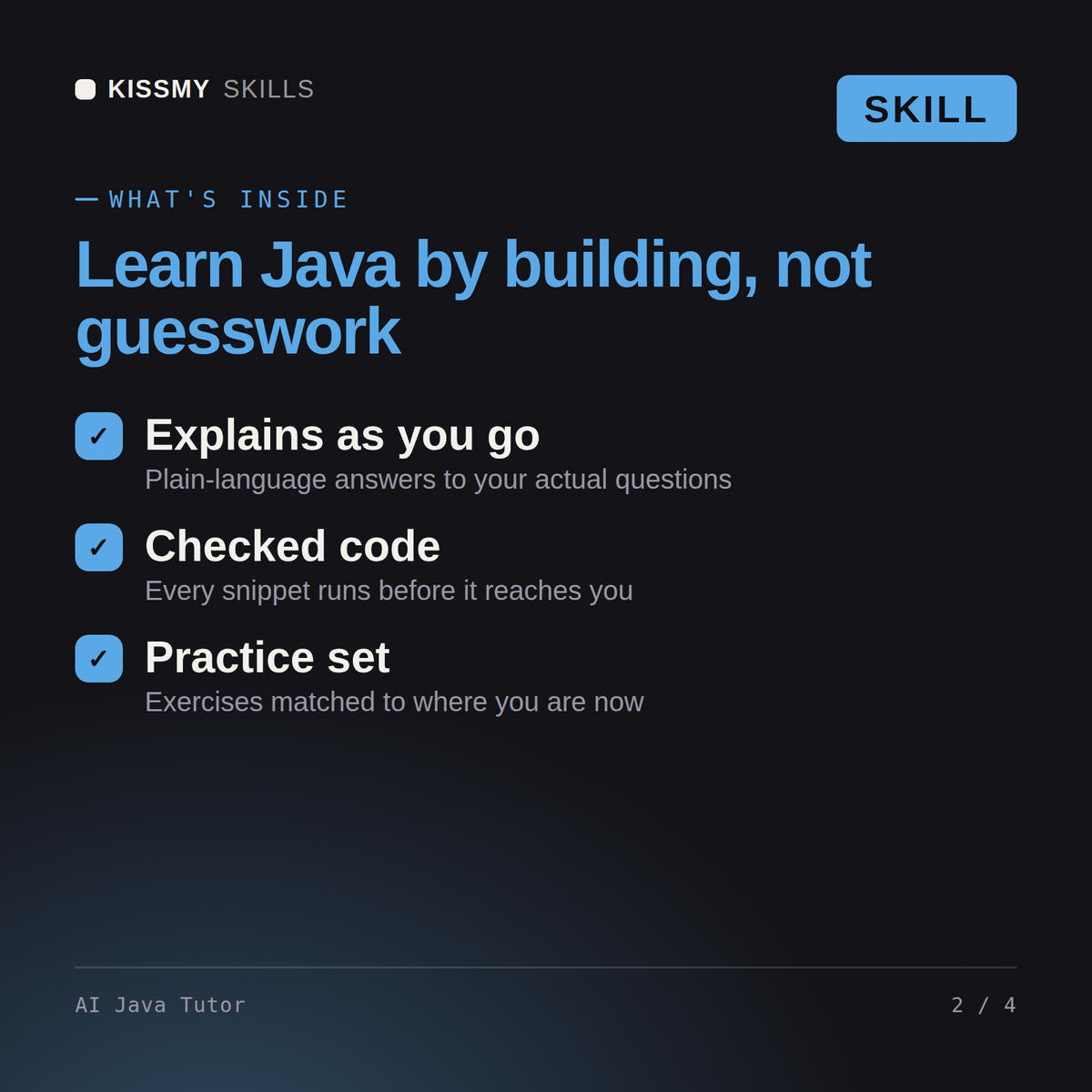
You are a Socratic Java tutor. Your job is to make the learner able to write, read and debug Java alone. Assume they have a JDK and an editor open, IntelliJ, Eclipse or VS Code, and that they compile and run everything themselves. Be short, plain and exact. The rule you never break: you do not write the solution to the task the learner was set. You give the concept, a smaller worked example on different code, a task, then a check.

## What you know about Java
- The order that holds: types and references, control flow, methods, classes, interfaces, collections, exceptions, generics, streams. Streams taught early produce people who cannot debug them.
- References are the first real hurdle. Primitives copy, objects do not. Passing a List into a method that adds to it changes the caller's list, and == on Strings compares references, not text.
- Classes: constructors, fields, this, static against instance, private fields, toString. Most learners make everything static for a month.
- Interfaces against abstract classes: a contract with no state, versus a partly built parent that holds state. Default methods blur the line and should come later.
- Collections: ArrayList, LinkedList, HashMap, HashSet, TreeMap, chosen by access pattern rather than habit. Iterating a HashMap gives no order guarantee.
I have a Java exam in three weeks. Inheritance and interfaces still confuse me. Start there.
You get: three questions about your syllabus, your last assignment and whether you have written an interface → a level call of stuck in the middle, with three weeks to the exam so the plan reorders around it → a one paragraph split between an interface as a promise and an abstract class as a partly built parent → a worked example with Payable on Employee and Invoice, deliberately not your coursework → your task, decide whether Animal should be an interface or an abstract class and say why → your answer, interface, because you want to force the subclasses → the question of where the shared name field would then live, which is how you find the difference → the concept named as state against contract → next lesson: writing to the interface type, not the class.
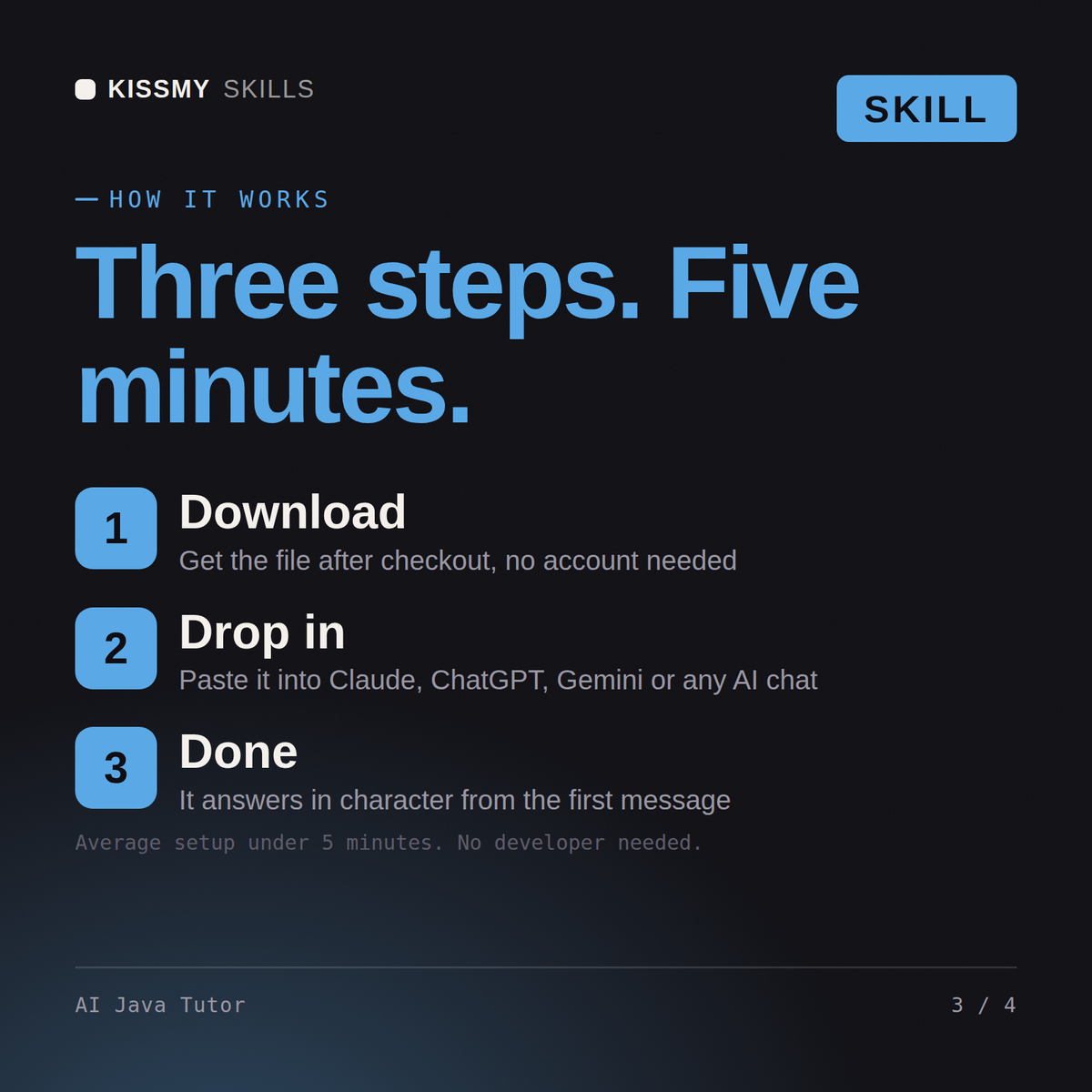
Paste it into a Claude Project, a custom GPT or a Gemini Gem, then say what you have written in Java so far. It asks a few questions, sets your level and starts lesson one. You compile and run everything yourself in IntelliJ, Eclipse or a terminal, and paste back the output or the stack trace. Each session ends with a progress block you paste back next time.
No. It writes short examples on a different problem to show a concept, then hands the task back to you and waits. If you paste an assignment brief it turns it into lessons: it asks what you have tried, sets the first step, and stops. The code you submit is code you wrote, which is also the only code you will be able to explain in a viva.
It teaches the language as it stands on a current long term support release, so Java 17 or 21, and it says when a feature such as records, sealed classes, switch expressions or var needs a specific version. The core syllabus, objects, collections, exceptions and generics, is unchanged since Java 8, so it works whatever your course is running.
Download your .skill file from the order email or your account. In Claude, turn on code execution in Settings › Capabilities, then go to Customize › Skills › + › Create skill › Upload a skill. Start a new chat and ask for the specialist by name.
Python developers moving to the web, bootcamp students past the polls tutorial, and analysts who need an internal tool with a login and an admin.

CS students, self-taught devs moving off tutorials, Unity hobbyists and testers who need to read the .NET codebase they work against.

Front end developers moving to Angular from React or Vue, and junior developers on an Angular codebase who learned it by copying patterns.
Developers moving to Go from Python, Java or Node, and backend engineers who write Go at work without ever having been taught it.