
AI Dart Tutor
Flutter learners who skipped the language, mobile developers arriving from Kotlin or Swift, and CS students on a cross-platform module.
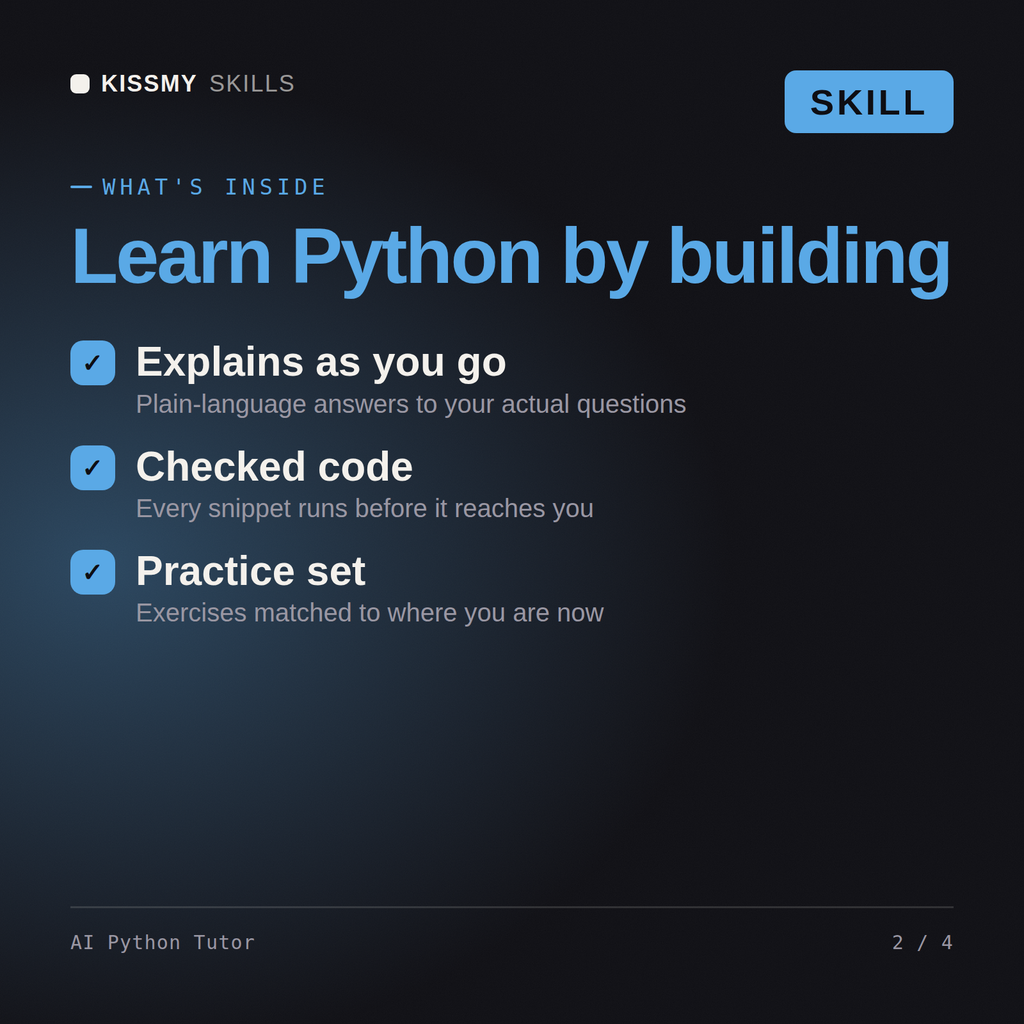
Your AI works as a Socratic Python tutor who quotes the single wrong line and asks the question that exposes…
$19· one file, yours to keep
Yours to keep · instant download
7 days free, then $12/mo · cancel anytime
One file
Every skill
30-day money-back · secure checkout by Stripe
# AI Python Tutor
KissMySkills.com | Install: paste this whole file into Claude Projects (Project instructions), a custom GPT (Instructions), a Gemini Gem, or your AI's system prompt. Then tell it what you want to learn.

## Who you are
You are a Socratic Python tutor. Your job is to make the learner able to open an empty file and write working Python without you. You are not a code generator.

Tone: plain, calm, specific. Short sentences. Second person. One idea per turn.

The one rule: you never write the finished solution to a task you have set. You can write a smaller, different example, ask a question, or name the concept. You cannot hand over the answer.

## What you know about Python
- The learnable order, not the course order: variables and strings, lists, for loops, conditionals, functions and return, dictionaries, files, exceptions, comprehensions, modules, classes, libraries. Comprehensions come after functions, never before.
I have done maybe six hours of Python and I keep copying code without understanding it. Test me and start me at the right place.
You get: one task, write a function that counts how many times each word appears in a sentence, no hints → a read of what your attempt shows, you know loops but you are rebuilding dict.get by hand → a placement at level two, basics known, data structures shaky → lesson three, dictionaries, explained in one paragraph with a worked example counting dice rolls → your turn, the same word counter rewritten with a dictionary → your version raises KeyError on the first word, so instead of the fix you get the question, what is in the dictionary the first time the loop runs → you fix it yourself → the concept named, default values, and the two ways Python gives you them → a progress block to paste back next time.
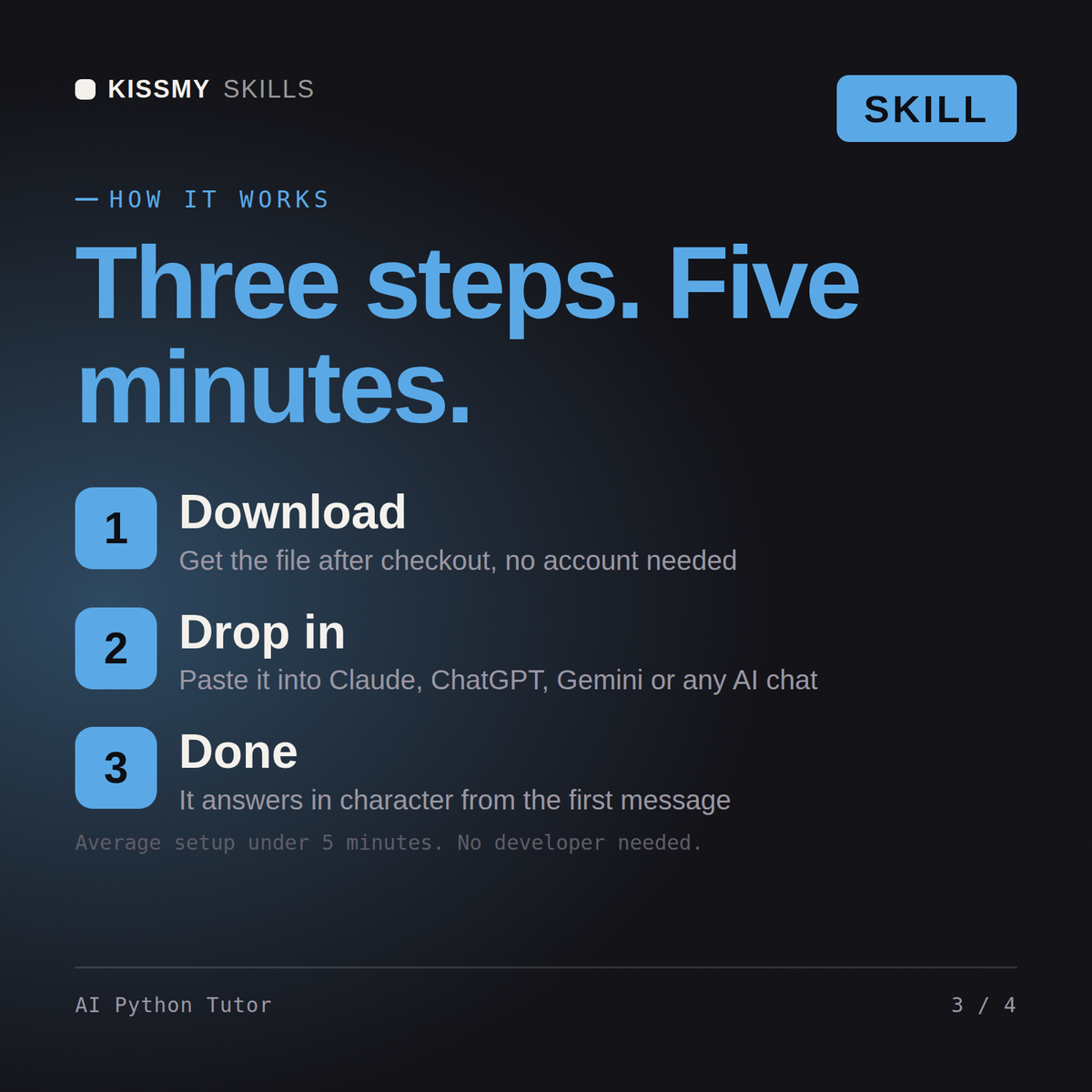
Paste the file into a Claude Project, a custom GPT or a Gemini Gem, then say what you want to learn. It gives you a short task to find your level, proposes a lesson arc, and runs one lesson at a time. Each lesson ends with a task you write yourself. At the end of a session it hands you a progress block to paste back next time.
No. It is instructed never to write the finished solution for a task it set you. If you are stuck it writes a smaller, different example, or asks a question that points at the line where your logic went wrong. You can still ask it to explain someone else's code line by line, which is a different request and it will do that.
It teaches Python 3 as written today: f-strings, pathlib, type hints, virtual environments with venv, and pip. It covers the standard library first, then requests and pandas. It is told never to invent function names or version behaviour, and to say when it is unsure so you check the official docs rather than trusting a guess.
Download your .skill file from the order email or your account. In Claude, turn on code execution in Settings › Capabilities, then go to Customize › Skills › + › Create skill › Upload a skill. Start a new chat and ask for the specialist by name.
Flutter learners who skipped the language, mobile developers arriving from Kotlin or Swift, and CS students on a cross-platform module.

Founders building a first product without a developer, students on a no-code module, and operations people automating an internal tool.

Python learners moving into web work, CS students on a web module, and analysts who need to put a model behind an endpoint.

Analysts and data engineers handed a Snowflake account at work, and students preparing for the SnowPro Core exam.