AI Marketing for Beginners: Your 30-Day Roadmap to Real Results

AI Marketing for Beginners: Your 30-Day Roadmap to Real Results | KissMySkills

AI Marketing Tools for Beginners: Why Most People Quit Before They Get Results

The typical beginner's journey with AI marketing tools follows a predictable and disappointing pattern. Someone discovers Claude or ChatGPT, reads that it's "transforming marketing," creates a free account, tries it for one task, gets mediocre output, concludes AI is overhyped, and returns to doing everything manually. Two months later, they read another article about AI marketing, feel guilty for giving up, and promise themselves they'll try again soon. They never do.

The failure point in this pattern is almost always the same: the first attempt used no context, no role instruction, and no structure — producing exactly the kind of generic, bland, corporate-sounding output that confirmed the sceptic's suspicion that AI writing wasn't actually useful. The user's conclusion ("AI doesn't work for serious marketing") was based on a test that any experienced AI user would recognise as set up to fail. The tools are genuinely capable. The deployment was flawed.

This 30-day AI marketing tools for beginners roadmap is designed to break that pattern. It starts with tasks where the AI advantage is so clear that even a poorly-briefed first attempt produces useful output, then systematically builds the skill that produces compound improvement week after week. By day 30, you will be running a configured AI workflow that saves 5-8 hours per week of your actual marketing time — with measured, before-and-after data to prove it.

The Four Skills Every AI Marketing Beginner Needs to Learn (In This Order)

Before the week-by-week plan, understand what you're actually learning. Effective AI marketing comes down to four sequential skills:

  1. Task recognition — Knowing which marketing tasks AI handles well (writing, summarising, structuring, generating variants) and which tasks still benefit more from human work (novel creative concepts, relationship-heavy communication, high-stakes strategic decisions).
  2. Prompt structure — Learning the four-part request pattern (role + context + task + format) that consistently produces useful output rather than generic noise.
  3. Workflow design — Turning one-off successful prompts into reusable templates and recurring workflows that compound time savings month after month.
  4. Configuration — Loading skill files and brand context into Claude's system prompt so every session starts from a specialist baseline rather than blank-slate mode.

The 30-day roadmap below develops each skill in sequence, starting easy and building to the configuration layer that produces compounding returns indefinitely.

Week 1: One Tool, One Task, One Win

Goal: Get one piece of work done with AI that demonstrably saves you meaningful time — building the first-hand confidence that the rest of the roadmap depends on.

Day 1-2: Create Your Account and Run Your First Task

Go to claude.ai and create a free account. No payment required, no commitment, no credit card on file. Spend 20 minutes doing one task you already know how to do manually: write a follow-up email, create a social media post, summarise a document you received this week, draft an internal announcement. Pick something small and low-stakes.

Important: time yourself. Compare the total time with Claude (including the editing pass) against how long the same task would have taken you manually. This single data point is your personal benchmark — the thing that makes the AI case concrete rather than theoretical.

If your first task is content
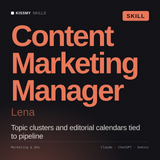
Lena — Content Marketing Manager AI Skill

Skip the blank-page version of Day 1-2. Lena already knows content structure, topic clusters and editorial calendars — so your very first task starts from a specialist baseline instead of a generic prompt.

View Lena — Content Marketing Manager ($24) →

Day 3-5: Iterate the Same Task With More Context

Do the same task three more times over the next three days, adding more context to each attempt. First version: basic request ("Write a follow-up email to a client who hasn't replied"). Second version: adds audience ("...to a senior marketing director who's been quiet for two weeks after showing initial interest"). Third version: adds tone and goal ("...tone should be professional but warm, goal is to re-open conversation without pressure").

Notice the output quality increase as context is added. Document the specific context additions that produced the biggest jump. This is where you start building intuition for what Claude actually needs from you.

Day 6-7: Try Your Second Task Type

Pick something from the opposite end of your work — if your first task was writing, try research synthesis, planning, or analytical work. Paste a long document and ask for a structured summary with key decisions. Paste a competitor's website copy and ask for positioning analysis. Brief Claude on a problem and ask for a structured approach. Notice how different tasks need different prompt patterns.

Week 2: Learn the Four-Part Prompt Structure

Goal: Produce consistently useful output rather than inconsistently good output.

Every useful AI marketing request has four components, and learning to include all four transforms your AI output quality within a week:

  • Role — Who is Claude? "Act as a senior B2B marketing copywriter with 10 years of SaaS experience."
  • Context — What are you working on? "I'm marketing a project management tool for remote engineering teams at mid-market companies."
  • Task — What specifically do you need? "Write a 5-email welcome sequence for new trial users who haven't yet invited teammates."
  • Format — How should the output be structured? "Each email: 100-150 words, subject line under 50 characters, CTA button text included, tone is friendly-professional."

Spend week 2 applying this structure to every request you make. Keep a note of the prompts that produce the best output — this is the beginning of your personal prompt library. By the end of week 2, you should be producing first-draft AI output that requires editing rather than full rewriting. If you're still rewriting most output, the prompt structure needs more context or more specific task instruction.

Week 3: Build Your First Workflow Template

Goal: Replace one recurring weekly task with an AI-assisted workflow you can run indefinitely.

Identify the task you spend the most time on each week that involves thinking and writing. Typical candidates: weekly newsletter, campaign brief, social content calendar, team status update, meeting prep document. Build a reusable prompt template for this task using the four-part structure, with placeholders (in [BRACKETS]) for the variable parts.

Example workflow template for a weekly newsletter:

Role: Act as a B2B marketing copywriter with strong email expertise.
Context: I write the weekly newsletter for [COMPANY], which sells [PRODUCT] to [AUDIENCE]. Our tone is [TONE ADJECTIVES].
Task: This week's newsletter theme is [THEME]. The key message is [MESSAGE]. We have these assets to feature: [ASSETS].
Format: Write: (1) subject line under 50 characters, (2) preview text under 90 characters, (3) opening paragraph 2-3 sentences, (4) body section 150-200 words, (5) CTA line with specific action. Output as clearly labelled sections.

Save this template somewhere accessible. Use it every time you write the newsletter. The first workflow alone typically saves 2-3 hours per week once you refine it.

Skip the DIY template
AI Marketing Funnel Builder

Instead of building your week-3 workflow template from scratch, this ready-made prompt pack designs the full customer-journey funnel — channels, content, conversion events, and metrics — specific to your business in one pass.

View AI Marketing Funnel Builder ($12) →

Week 4: Configure Claude for Your Role Permanently

Goal: Make Claude permanently context-aware for your work, so every session starts from a specialist baseline.

Download the KissMySkills skill file for your role — marketing, content, email, advertising, or whatever function matches your actual work. Load the skill file into Claude's system prompt settings. Add a brand context block: your company, your product, your audience, your brand tone in 3-5 adjectives, and any forbidden phrases or required elements your brand requires.

The configured version of week 4
Sofia — Growth Marketing Strategist AI Skill

Rather than assembling your own brand context block by hand, drop Sofia into Claude and get growth audits, CAC/LTV models and channel strategy loaded as permanent background — configured on day one instead of day 30.

View Sofia — Growth Marketing Strategist ($29) →

Now run every task from the previous three weeks again using the configured Claude. Notice the difference. The first drafts need less editing. The brand voice is consistent without being re-specified each time. The strategic depth is deeper because the skill file loaded professional-grade marketing context. This is the compounding return on the month's investment — you will keep benefiting from this configuration for months to come, with zero ongoing effort.

Day 30: Measure Your Time Savings and Plan the Next Expansion

Compare day 30 metrics against day 1 benchmarks:

  • How long does the first weekly task now take compared to manual?
  • How many additional tasks have moved into the AI-assisted workflow?
  • What has been the cumulative time saving across the month?

The average marketer following this 30-day AI marketing tools for beginners roadmap reports 5-8 hours per week saved by the end of month 1, with measurable quality improvements on the content AI produces. Month 2 typically doubles those savings as more recurring tasks get templated. Month 3 becomes the point where AI marketing tools feel permanently embedded rather than experimental.

The Mistake Beginners Make After Day 30

The most common post-roadmap mistake: trying to immediately AI-enable every task across every marketing function, rather than deepening the workflows already working. The teams that get the most compound value from AI marketing tools add one new workflow per month and refine existing ones continuously — rather than building 20 half-working workflows that nobody uses properly.

Your roadmap after day 30: one new workflow per month, each built using the same template structure. By month 6, you're running 6 AI-assisted workflows covering the highest-frequency tasks in your week. By month 12, AI is genuinely embedded in how you work — not a tool you use occasionally, but the infrastructure your marketing function runs on. Browse the KissMySkills skill file catalog at KissMySkills.com to get your configured starting point for week 4 today.

In summary:

If content is your first win, start with Lena (Content Marketing Manager); for your week-3 workflow template, the AI Marketing Funnel Builder gets you there in one pass; for the full week-4 configuration, Sofia (Growth Marketing Strategist) loads growth context permanently. All work in Claude, ChatGPT and Gemini with no coding and a 30-day money-back guarantee, or browse Marketing & Ads skills.

Ready to put this into practice? Browse Marketing & Ads skills for Claude & ChatGPT, or explore all Claude skills and the prompt library.

Frequently Asked Questions

Why do most beginners quit AI marketing tools before getting results?

The typical beginner's journey with AI marketing tools follows a predictable and disappointing pattern. Someone discovers Claude or ChatGPT, reads that it is transforming marketing, creates a free account, tries it for one task, gets mediocre output, concludes AI is overhyped, and returns to doing everything manually. The failure point in this pattern is almost always the same: the first attempt used no context, no role instruction, and no structure, producing exactly the kind of generic, bland, corporate-sounding output that confirmed the skeptic's suspicion that AI writing was not actually useful. The user's conclusion (AI does not work for serious marketing) was based on a test that any experienced AI user would recognize as set up to fail. The tools are genuinely capable. The deployment was flawed. The beginner needed task recognition, prompt structure, workflow design, and configuration skills but tried to jump straight to output without building any of these foundations.

What are the four skills every AI marketing beginner needs to learn?

Four sequential skills: Task recognition (knowing which marketing tasks AI handles well including writing, summarizing, structuring, generating variants and which tasks still benefit more from human work including novel creative concepts, relationship-heavy communication, high-stakes strategic decisions). Prompt structure (learning the four-part request pattern of role plus context plus task plus format that consistently produces useful output rather than generic noise). Workflow design (turning one-off successful prompts into reusable templates and recurring workflows that compound time savings month after month). Configuration (loading skill files and brand context into Claude's system prompt so every session starts from a specialist baseline rather than blank-slate mode). The 30-day roadmap develops each skill in sequence starting easy and building to the configuration layer that produces compounding returns indefinitely.

What is the four-part prompt structure for getting better AI output?

Every useful AI marketing request has four components, and learning to include all four transforms your AI output quality within a week: Role (who is Claude, example: Act as a senior B2B marketing copywriter with 10 years of SaaS experience). Context (what are you working on, example: I am marketing a project management tool for remote engineering teams at mid-market companies). Task (what specifically do you need, example: Write a 5-email welcome sequence for new trial users who have not yet invited teammates). Format (how should the output be structured, example: Each email 100-150 words, subject line under 50 characters, CTA button text included, tone is friendly-professional). Spend week 2 applying this structure to every request you make. Keep a note of the prompts that produce the best output, this is the beginning of your personal prompt library. By the end of week 2 you should be producing first-draft AI output that requires editing rather than full rewriting.

What should beginners focus on in their first 30 days with AI marketing tools?

Week 1: One tool, one task, one win (create account, run your first task, time yourself and compare against manual time, iterate the same task with more context over 3-5 days, try your second task type). Week 2: Learn the four-part prompt structure (role, context, task, format applied to every request, keep a note of prompts that produce the best output, by end of week 2 you should be producing first-draft output that requires editing rather than full rewriting). Week 3: Build your first workflow template (identify the task you spend the most time on each week that involves thinking and writing, build a reusable prompt template using the four-part structure with placeholders in brackets for the variable parts, save this template somewhere accessible and use it every time, the first workflow alone typically saves 2-3 hours per week once refined). Week 4: Configure Claude for your role permanently (download the KissMySkills skill file for your role, load the skill file into Claude's system prompt settings, add a brand context block, run every task from previous three weeks again using the configured Claude). Day 30: Measure your time savings and plan the next expansion.

What mistake do beginners make after completing a 30-day AI marketing roadmap?

The most common post-roadmap mistake: trying to immediately AI-enable every task across every marketing function rather than deepening the workflows already working. The teams that get the most compound value from AI marketing tools add one new workflow per month and refine existing ones continuously, rather than building 20 half-working workflows that nobody uses properly. Your roadmap after day 30: one new workflow per month each built using the same template structure. By month 6 you are running 6 AI-assisted workflows covering the highest-frequency tasks in your week. By month 12 AI is genuinely embedded in how you work, not a tool you use occasionally but the infrastructure your marketing function runs on. The average marketer following this 30-day roadmap reports 5-8 hours per week saved by the end of month 1 with measurable quality improvements. Month 2 typically doubles those savings as more recurring tasks get templated.

Frequently asked questions

~/get-started

Skills that work. No fluff.

Browse every skill, prompt pack, and agent in the store.

Browse all skills →Or start with free skills